


Every new sales channel, acquisition, and SaaS rollout adds another system that has to exchange data reliably, and every shortcut taken along the way becomes a maintenance cost later. Market research points the same way, with Fortune Business Insights projecting a 21.70% compound annual growth rate from a USD 6.89 billion base in 2025. This guide compares eight firms and gives buyers a practical framework for shortlisting partners against their own architecture and delivery needs.
Executive Summary
API and system integration connects applications, data stores, and services so that business processes and data move reliably across the enterprise. Done well, it removes data silos, shortens the time needed to launch new digital products, and lowers the cost of maintaining fragile point-to-point connections.
Buyers comparing integration partners need a common yardstick. This guide sets eight firms side by side and measures each one against five criteria: architecture depth, API governance, legacy modernization experience, delivery model, and platform fit.
Who Is This Guide For?
Chief Technology Officers setting integration architecture and platform strategy
VPs of Engineering accountable for delivering API and integration programs
Enterprise Architects defining standards for API design and system connectivity
Procurement and Sourcing Leads comparing partners on delivery model and total cost
Digital and Application Owners responsible for connecting customer-facing systems
Each role shares the same goal: connecting systems reliably while keeping security, governance, and cost under control.
What Is API & System Integration & How Does It Work?
API and system integration is the practice of designing, building, and operating the interfaces that let software systems exchange data and trigger actions. An API exposes a defined set of operations to other applications, while integration connects systems such as enterprise resource planning (ERP), customer relationship management (CRM), data platforms, and SaaS applications. Mature programs combine API design standards, middleware or integration platforms, security controls, and monitoring so that each connection is reusable, governed, and observable.
Common models and approaches include:
Point-to-point integration: Direct connections between two systems. These are quick to build but become costly to maintain as the number of connections grows.
Middleware and enterprise service bus: A central layer that routes, transforms, and monitors messages between systems.
Integration platform as a service (iPaaS): Cloud-hosted tools, such as MuleSoft, Dell Boomi, and Azure Logic Apps, that provide prebuilt connectors and managed runtimes.
API-led connectivity: Layered APIs for systems, processes, and experiences, so teams can reuse integration assets across projects.
Event-driven integration: Systems publish and subscribe to events through streaming platforms such as Apache Kafka, enabling near real-time data flow.
Key Advantages of API & System Integration
Faster delivery of new digital products because reusable APIs let teams build new channels on existing business logic without rebuilding it.
Lower maintenance cost because a governed integration layer replaces dozens of brittle point-to-point connections with a small set of managed interfaces.
Consistent data across systems because transformation and synchronization rules live in one place and are not duplicated inside each application.
Stronger security and access control because authentication, authorization, rate limiting, and logging are enforced at the API layer.
Real-time responsiveness because event streaming lets downstream systems react to business events as they occur.
Incremental legacy modernization because APIs let organizations replace older systems behind a stable interface one component at a time.
How To Choose the Best API & System Integration Partner?
Evaluate each firm on how it handles your specific systems, risks, and team model.
API architecture and design depth: Confirm the partner designs REST, GraphQL, and event-driven APIs against documented standards. Ask for design artifacts and governance documentation from prior engagements.
Platform and cloud certification fit: Match partner certifications to the platforms you run, such as Microsoft Azure, AWS, Google Cloud, or Confluent. Certifications alone do not prove delivery, so pair them with reference projects on the same stack.
API security and lifecycle management: Evaluate how the partner handles authentication, authorization, rate limiting, versioning, and API retirement. Your own security team should review the security design before build begins.
Legacy modernization experience: Integration programs often touch decades-old systems. Look for partners who have re-engineered legacy interfaces, such as SOAP-to-REST conversions, without disrupting live operations.
Event-driven and real-time capability: If your business depends on near real-time data, verify that the partner has run streaming architectures in production, beyond batch ETL pipelines.
Delivery model flexibility: Decide whether you need a fixed-scope project, a managed team, or embedded staff augmentation, and confirm the partner offers that model. Each suits a different level of internal ownership.
Knowledge transfer and developer enablement: Ensure the partner leaves behind documentation, developer portals, and trained internal staff so your team can maintain the integration.
Client references and measurable outcomes: Request references in your industry and ask for quantified results, such as reduced integration time or cost, and treat general satisfaction claims as a weak signal.
Three questions to put to every shortlisted firm:
Which production integrations have you delivered on the platforms we run today?
Which governance artifacts will we own when the engagement ends?
How will you measure integration reliability and performance after go-live?
Weigh each partner on its API governance, platform certifications, and delivery model against your integration roadmap.
API & System Integration Companies Compared
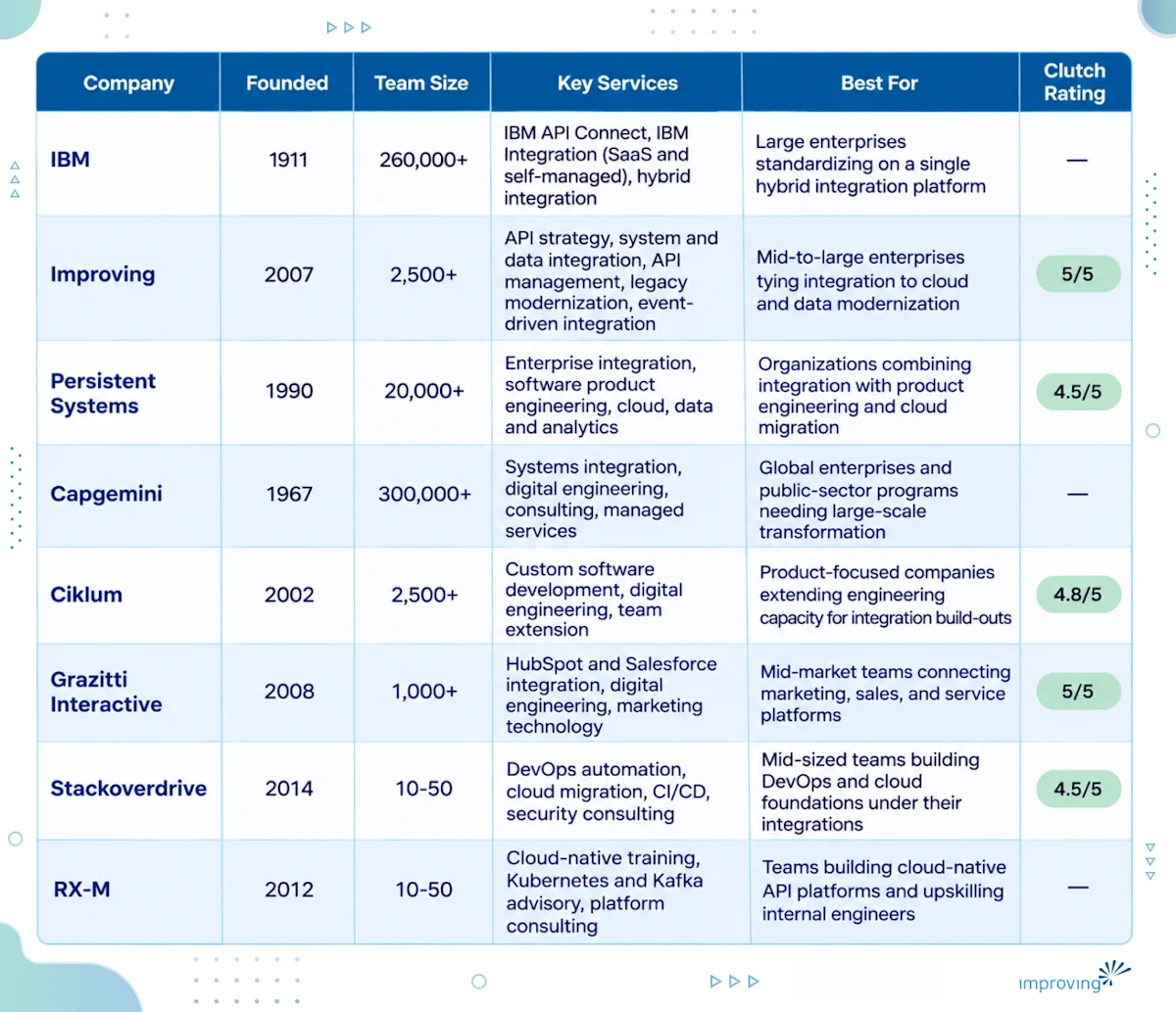
Top 8 API & System Integration Companies
1. IBM
IBM offers integration and API management through IBM API Connect and IBM Integration, the platform formerly known as IBM webMethods Hybrid Integration. Founded in 1911 and headquartered in Armonk, New York, IBM is known for serving large, regulated enterprises with long-running middleware estates.
Headquartered: Armonk, New York, USA
Team Size: 260,000+
Key verticals: Financial services, government, and large regulated enterprises
Key platforms/technologies: IBM API Connect, IBM Integration, IBM Cloud Pak for Integration
Relevant strengths: Hybrid integration breadth, large-scale enterprise support, and a single vendor for middleware and API management
Why Consider IBM? IBM is a strong fit for enterprises that want one platform vendor for API management, messaging, and hybrid integration across mainframe and cloud estates.
Talent Pool Access: IBM's workforce of roughly 260,000 supports large enterprise programs worldwide.
Proven Track Record: IBM positions API Connect as its platform for API management across hybrid environments.
2. Improving
Improving Enterprises delivers API development and system integration across cloud, on-premises, and hybrid environments. Its integration practice combines consulting-led strategy with engineering-led delivery, and it is platform-agnostic, selecting tools such as MuleSoft, Azure API Management, AWS API Gateway, Google Apigee, Kong, and Confluent Kafka for each engagement. Its expertise centers on real-time data streaming, API governance and security frameworks, and legacy modernization, delivered by certified architects across all major cloud platforms.
Why Is Improving the Best API & System Integration Partner?
We pair structural differentiation with delivery discipline. Our integration engagements follow a structured five-phase methodology (Discover, Design, Develop, Demonstrate, Deploy) that gives clients transparency into risk and schedule at every stage, and our teams bring proven frameworks for API governance and security.
NPS 90+: among the highest in modern enterprise technology services.
7.5-year average partnership length: built around long-term relationships that extend beyond single projects.
Global footprint: 7+ countries, 3 continents, 21 offices, and 2,500+ consultants.
Key verticals: Retail, financial services, insurance, healthcare, and aviation.
Platform stack: MuleSoft, Azure API Management, AWS API Gateway, Google Apigee, Kong, Confluent Kafka.
Relevant strengths: Certified architects across major clouds, API governance frameworks, and legacy modernization.
Global Delivery Access
Our integration teams operate across the Americas and India, and our engineers hold certifications across AWS, Microsoft Azure, Google Cloud, Databricks, and Confluent. Clients get delivery staffed to the platforms they already run, with project, managed-team, and staff augmentation models available.
Proven Track Record
Thrivent, a client-owned financial services organization, had slow, siloed data systems and legacy platforms such as SIFT and the mainframe. Improving built the Thrivent Enterprise Integration Datastore (TEID) on Confluent Kafka, DynamoDB, and GraphQL to consolidate data for real-time use across web and mobile apps. The result: faster web and mobile applications, less data redundancy, a move off legacy systems, and more confident decisions based on real-time data.
Looking to achieve similar results with a trusted partner? Connect with our integration experts to explore how we can accelerate your integration roadmap.
Strategic Advantage
Our API and integration practice pairs category expertise with named partnerships: a Microsoft Solutions Partner designation covering Azure Integration Services, Logic Apps, and API Management; an AWS partnership covering API Gateway and Lambda; and a Confluent partnership for event-streaming architectures. Combined with certified engineers and production event-streaming experience, that combination gives enterprises a partner that can design the governed API layer and the real-time data flow in one program.
3. Persistent Systems
Persistent Systems is an IT services and software engineering company headquartered in Pune, India, founded in 1990. It combines software product engineering with cloud, data, and enterprise integration work for large technology and enterprise clients.
Headquartered: Pune, India
Team Size: 20,000+
Key verticals: Banking and financial services, insurance, healthcare, life sciences, telecom and media
Key platforms/technologies: AWS, Microsoft, Google Cloud, IBM, Salesforce, Appian, Red Hat
Relevant strengths: AWS Premier Tier Partner status, Microsoft solution areas across all six designations, and AI platforms including GenAI Hub (self-reported)
Why Consider Persistent Systems? Persistent is a strong choice for organizations that want integration delivered alongside product engineering and cloud migration under one partner.
Talent Pool Access: Persistent operates a large engineering workforce in India with delivery centers serving clients across North America, Europe, and Asia.
Proven Track Record: Persistent's partner pages report more than 100,000 workloads migrated on Microsoft platforms and 2,660+ AWS Cloud certifications (self-reported).
4. Capgemini
Capgemini is a French multinational IT services and consulting company headquartered in Paris, founded in 1967. It is known for large-scale systems integration, digital engineering, and managed services, and it works with large enterprises and public-sector organizations on complex transformation programs.
Headquartered: Paris, France
Team Size: 300,000+
Key verticals: Large enterprise and public sector across multiple industries (self-described)
Key platforms/technologies: MuleSoft, Boomi, IBM webMethods, Workato, SAP, Microsoft Azure, AWS, Google Cloud, Apigee
Relevant strengths: Scale, integration breadth across multiple vendors, and transformation program management
Why Consider Capgemini? Capgemini suits global enterprises that need a systems integrator capable of staffing very large, multi-country integration programs.
Talent Pool Access: Capgemini draws on a workforce of hundreds of thousands worldwide.
Proven Track Record: Capgemini reports 15,000+ Microsoft-certified integration professionals and more than 10 MuleSoft-to-Azure modernization projects.
5. Ciklum
Ciklum is an international software development and digital engineering company headquartered in London, founded in 2002. Its integration work is delivered within broader custom software and engineering engagements, with a strong focus on banking, financial services, insurance, and hi-tech clients.
Headquartered: London, United Kingdom
Team Size: 2,500+
Key verticals: Banking, financial services and insurance; hi-tech
Key platforms/technologies: Microsoft (partner since 2018), NVIDIA, AWS
Relevant strengths: Cloud-native engineering, AI-driven development, and compliance-aware platform builds for regulated industries
Why Consider Ciklum? Ciklum is a good fit for product organizations that want to extend engineering capacity and build integrations as part of a broader custom software program.
Talent Pool Access: Ciklum offers team extension and dedicated delivery models that add engineering capacity to existing product teams.
Proven Track Record: Ciklum reports that its Microsoft partnership under the AI Cloud Partner Program covers Data and AI, digital and app innovation, and infrastructure.
6. Grazitti Interactive
Grazitti Interactive is a digital engineering firm best known for its HubSpot and Salesforce services. Clutch named it among the top five IT leaders for HubSpot services in 2022, and its integration work centers on connecting marketing, sales, and service platforms.
Headquartered: India
Team Size: 1,000+
Key verticals: High-tech, manufacturing, and nonprofit
Key platforms/technologies: HubSpot, Salesforce, Salesforce Marketing Cloud, Salesforce CPQ
Relevant strengths: HubSpot integration and migration services, Salesforce CPQ and revenue management, and marketing technology integration
Why Consider Grazitti Interactive? Grazitti is a strong fit for mid-market teams whose integration priorities center on marketing, sales, and customer-service systems.
Talent Pool Access: Grazitti reports more than 1,200 tech experts across the US, India, Australia, Canada, and Singapore.
Proven Track Record: Recognized by Clutch in 2022 among the top five companies globally as IT Leaders for HubSpot Services.
7. Stackoverdrive
Stackoverdrive is a New York-based DevOps and cloud consulting firm founded in 2014. It is known for infrastructure automation, continuous integration and delivery, cloud migration, and application and network security consulting, which provides the operational foundation many integration programs need.
Headquartered: New York, New York, USA
Team Size: 10-50
Key verticals: Financial services, real estate, and nonprofit
Key platforms/technologies: AWS (primary cloud focus), Google Cloud, Hadoop
Relevant strengths: DevOps automation, cloud migration, and security consulting
Why Consider Stackoverdrive? Stackoverdrive suits mid-sized teams that need DevOps and cloud foundations in place before building integrations on top of them.
Talent Pool Access: Stackoverdrive's team is small, roughly 10 to 49 people based in New York, which suits focused engagements over large multi-stream programs.
Proven Track Record: Clutch client reviews describe an AWS platform build for a financial technology firm, a backend overhaul for a voter-participation nonprofit with its hosting rebuilt and reported to have zero downtime, and an Airflow and Redshift monitoring ecosystem for a data analytics company.
8. RX-M
RX-M is a cloud-native and open source training and consulting firm, founded in 2012 and a charter member of the Cloud Native Computing Foundation. Its work centers on instructor-led training, cloud-native advisory, and platform consulting for teams building containerized and API-driven systems.
Headquartered: San Francisco, California
Team Size: 10-50
Key verticals: Financial services, including low-latency trading and risk systems
Key platforms/technologies: Kubernetes, Apache Kafka, cloud-native tooling
Relevant strengths: CNCF charter member, Linux Foundation Authorized Training Partner, and advisory-led engagements
Why Consider RX-M? RX-M suits teams building cloud-native API platforms that want to upskill internal engineers alongside the build.
Talent Pool Access: RX-M's team of roughly 10 to 50 people focuses on cloud-native platform and training engagements.
Proven Track Record: RX-M reports work with dozens of startups and Fortune 500 companies.
Closing: Building an Integration Partnership That Scales With Your Architecture
The strongest integration programs start with a clear picture of which systems matter most and which can wait. Whichever firm you shortlist, ask for evidence that it designs for the next integration as well as the current one: reusable APIs, documented governance, and internal teams who can run the platform after launch.
At Improving, we measure success by what our clients can operate on their own once we step back. We build governed API layers, streaming architectures, and modernization roadmaps alongside the teams who will own them. If you are weighing options now, explore our API development and system integration services or schedule a consultation to test your shortlist against your own architecture.
Frequently Asked Questions
1) What is the difference between an API and system integration?
An API is a defined interface that lets one application request data or trigger an action in another. System integration is the broader discipline of connecting applications, data stores, and services so they operate as one process. APIs are one of the main tools used to do it.
2) When should an enterprise choose iPaaS over custom integration?
Choose iPaaS when the connectors you need are standard, such as common SaaS and ERP applications, and speed to deployment matters more than custom logic. Choose custom API development when you need proprietary business logic, strict performance targets, or tight control over security design.
3) How long does an integration project typically take?
Duration depends on the number of systems, data complexity, and legacy constraints. Simple point integrations can reach production in weeks, while multi-system programs with legacy modernization often run for several months and are best scoped in phases.
4) How do you keep APIs secure as the number of integrations grows?
Use a central API gateway to enforce authentication, authorization, rate limiting, and logging. Require a documented API lifecycle with owners, versioning rules, and retirement dates, and run regular security reviews so the API catalog does not drift.
5) Should we build internal integration skills or outsource?
Most enterprises combine both. Partners typically deliver the initial architecture and build, while internal teams take ownership through documentation, developer portals, and paired delivery so the integration can be maintained after the engagement ends.
6) What should we ask a vendor before signing a contract?
Ask for production references on your platforms, the governance artifacts you will own at the end of the engagement, the delivery model and team composition, and how success will be measured after go-live.