
HOME > EXPERTISE > AI > AI MATURITY MODEL > WAVE 2: PROCESS
250+
AI Projects Delivered
$4.4B
ROI Generated for AI Clients
400+
Improvers in our AI practice
100+
AI Certified Experts

Improving's AI Maturity Model: 3 Waves, 8 Stages
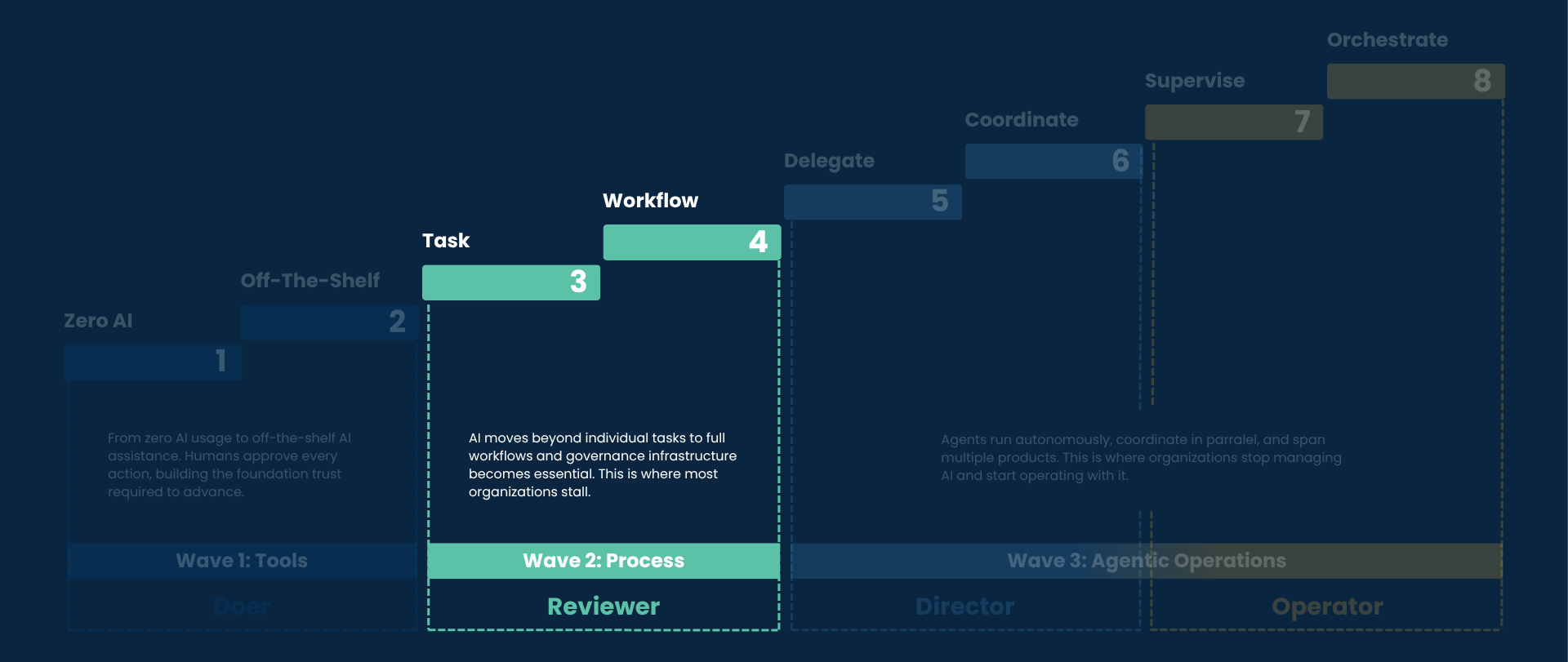
Wave 2 is where AI stops being something individuals use and starts being something the workflow depends on.
Wave 2: Two Stages and One Core Shift
Task
You give AI a defined task with real context. You craft prompts deliberately, set constraints, and review output critically. Example: "Write unit tests for this service class following our naming conventions and error handling patterns."
Reality Check:
No one measures whether a prompt change made things better
Quality gets judged case by case, against no written standard at all
"It seems better" is the only evaluation criteria anyone has
Workflow
You chain multiple AI steps into a repeatable process, making it a part of how the work flows. Example: a code review pipeline where AI drafts the review, flags security concerns, then a human approves or adjusts.
Reality Check:
AI steps are chained together with no check in between them
When the workflow breaks, nobody can tell which step failed first
A bad output early in the chain quietly contaminates everything after it

How Improving Help Organizations in Wave 2
The large firms sell scale. Boutiques sell specialization. We sell trust. Which is why 98% of clients rate their Improving engagement as meeting or exceeding expectations.
Workflow Observability Audit
Know exactly where AI is involved in your workflow, where outputs move between people or systems, and where mistakes could quietly spread before anyone notices. Gain visibility that makes AI workflows easier to debug, trust, and improve over time.
Governance & Handoff Design
Get clear ownership for every AI-touched step, know when human review is required, and have a defined rollback path when something goes wrong. Governance becomes part of how work gets done.
AI Readiness Assessment
Evaluate how your workflows measure up against Stage 4, and whether they have the observability, handoffs, and rollback paths needed for reliable, repeatable AI-driven execution.
Build, scale, and accelerate AI with the right technology partners: Microsoft | AWS | Google Cloud | Anthropic
Same Stage, Different Reality
Developer
"I write code AI helps me finish" vs. "I own a pipeline step AI executes and I review"
AI moves from autocomplete to task ownership with a review gate: it drafts the PR, generates the test, but a human still merges. The compounding effect starts here, because the AI's output now feeds the next step instead of ending at the editor.
Platform / Infra Engineer
"I discover AI sprawl after the fact" vs. "I build the governance layer before it's needed"
Starts building proactively instead of finding out a dev pasted AI-generated Terraform into a PR after the fact: audit trails, approval gates, rollback paths for AI-touched pipeline steps.
Support / Business Function
"I use AI as a personal shortcut" vs. "I trust AI with a full ticket category, sampled"
AI handles a full ticket category end to end, but a human spot-checks a sampled percentage rather than reviewing everything.
CIO / Exec Sponsor
"I track usage" vs. "I ask what happens when this breaks"
Starts asking for an incident model that what happens when this breaks, who’s accountable, what’s the blast radius.
Wave 2 in Practice
From 45-minute resident replies to 5, with a human still in the loop
Associa, the largest HOA management company in the U.S., had property managers spending significant time drafting replies to resident requests in their Town Square app, the platform's most-used and most-complained-about feature. Improving built a human-in-the-loop generative AI solution using AWS Bedrock, retrieval-augmented generation, and a tool-routing agent architecture: the system drafts a response grounded in community documents, and managers use, edit, or discard it before it goes out.
9x faster
Manager response time cut from 45 minutes to 5 minutes per request
Human-in-the-loop
Every AI-drafted reply is reviewed, edited, or discarded by a manager before it's sent
Our Practitioners Teach What They Build - Watch Them Do It
Every session is led by an Improving practitioner, the same people delivering AI engagements for enterprise clients. Deep technical content, real delivery experience, open to everyone.
Building Trust at Scale for Growth and AI: What to Do First, Next, and Later in Data Governance

Preston Mesarvey
Technical Director
Governance That Actually Works: How Well-Designed AI Systems Make Responsibility Visible

Devlin Liles
Chief AI Officer
Define the Need, Solve the Problem: An AI-First Playbook for Developers

Claudio Lassala
Technical Director


What Comes Next
The Process Wall
Moving from directing AI tasks to trusting AI systems requires observability, rollback design, acceptance criteria, and trust calibration, four things most teams never build for the task-level version.
The Trust Asymmetry
One bad hallucination at the workflow level does more damage than ten good outcomes build trust, because Wave 2 failures touch real downstream work, not just a suggestion someone reviews.
This is why AI teams quietly roll back workflow automation after one bad incident, even when the aggregate results were positive. It’s why Wave 3 requires an operating mode.
Wave 3 is where AI moves from executing bounded workflows to coordinating autonomously across them, and where the governance question shifts again: from "who authorized this workflow step" to "who's accountable when an agent takes an action no human reviewed in real time."

Ready to Move from AI Initiative to AI Impact?
Tell us where you are and we'll tell you exactly how we can help. No generic proposals, no sales pitch, just a direct conversation about your situation.
Devlin Liles
Chief AI Officer & CCO

David O'Hara
Regional Director

Tim Rayburn
VP of Consulting