
AI Maturity Model: Agentic Operations
Vendors call a scheduled script agentic. Teams call a chatbot with function-calling an agent. Neither is close to Stage 5. Only 17% have deployed AI agents, and 11% of pilots reach production. Wave 3 is the gap between the label and operating model.HOME > EXPERTISE > AI > AI MATURITY MODEL > WAVE 3: AGENTIC OPERATIONS
250+
AI Projects Delivered
$4.4B
ROI Generated for AI Clients
400+
Improvers in our AI practice
100+
AI Certified Experts

Improving's AI Maturity Model: 3 Waves, 8 Stages
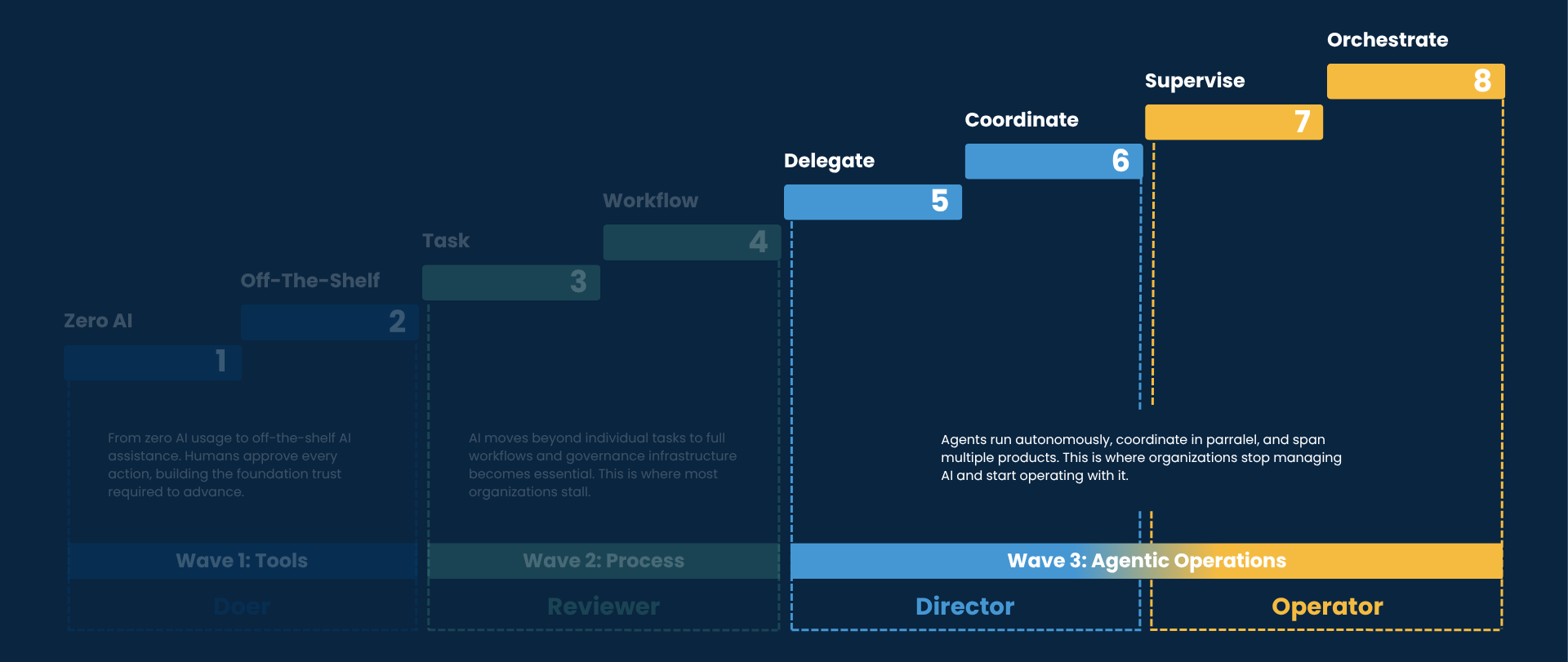
Organizations that reach Wave 3 have already solved for visibility (Wave 1) and workflow trust (Wave 2). This model is domain-specific. Your accounting team may be at Stage 2 while your dev team is at Stage 5.
Understanding AI Maturity: The 4 Core Stages of Wave Three
Delegate
You hand off entire sub-tasks to AI with clear success criteria. You define the “what” and “done,” AI figures out the “how.” Example: “Generate migration scripts for this schema change, include rollback, validate against staging.”
Signs you're here:
Agents have defined outcome without specifying the procedure
Success criteria are set upfront
Failure means the outcome missed the mark
Coordinate
Multiple AI agents work together on parts of a problem. You define the goal and boundaries. Example: “One agent researches, another drafts, a third reviews — you approve the final output.”
Signs you're here:
Two or more agents pass context to each other without a human relaying it
Boundaries are defined so agents don't act outside their part of the problem
Without shared arbitration, agents produce conflicting outputs nobody notices until reconciliation fails
Supervise
AI systems run continuously with human oversight. You monitor dashboards and intervene on exceptions. Example: “AI handles tier-1 support tickets end-to-end. Humans review escalations and edge cases.”
Signs you're here:
Nobody reviews individual actions in real time, only flagged exceptions
Performance is tracked as a system metric
Org has accepted some actions happen with no human in the loop, and has built for that
Orchestrate
AI manages other AI agents, allocating work and resolving conflicts. Humans set strategy and constraints. Example: “An AI orchestrator assigns dev tasks across coding agents, runs tests, and merges clean PRs.”
Signs you're here:
Strategy-level goals translate into agent behavior without manual re-specification at each layer
System self-corrects within bounds leadership set, not bounds re-approved weekly
Executive attention is on whether the model is performing against outcomes

How Improving Works With Organizations in Wave 3
The large firms sell scale. Boutiques sell specialization. We sell trust. Which is why 98% of clients rate their Improving engagement as meeting or exceeding expectations.
Wave 3 is a different offering than a Wave 2 engagement, because the thing being built is an operating model. Engagements at this stage typically start with an Agentic Landing Zone assessment, a pre-configured foundation for deploying agents safely without building infrastructure from scratch.
Governance
Policy management, compliance, and audit built into the agent layer.

Orchestration
Agent coordination and workflow management for the agents that hand off context and work in parallel.
Tool Registry
Approved integrations and a capability catalog, so every agent's access is deliberate, approved access for every agent.

Knowledge
RAG infrastructure and context management, so agents work from your organization's actual knowledge.
Observability
Monitoring, logging, and performance tracking across every agent, so nothing runs where nobody's watching.

Security
Access control, encryption, and boundaries, so an agent's reach is scoped as tightly as a human's would be.
Build, scale, and accelerate AI with the right technology partners: Microsoft | AWS | Google Cloud | Anthropic
Same Stage, Different Reality
Developer
"I own a pipeline step AI executes" vs. "I define agent behavior, guardrails, and evaluation criteria"
The code increasingly becomes a spec an agent executes against. AI's productivity gain isn't uniform here: research shows senior developers can slow down verifying AI output even as junior developers speed up, exactly the tension Stage 5 delegation has to design around.
Platform / Infra Engineer
"I build the governance layer before it's needed" vs. "I own the agent orchestration layer itself"
Identity and authorization now apply to agents, not just humans. Deciding which agents can act, what they can change, and how conflicts resolve becomes the actual infrastructure job.
Support / Business Function
"I trust AI with a full ticket category, sampled" vs. "A full function runs under agent coordination, humans supervise exceptions only"
The shift from spot-checking a percentage to only seeing what got flagged. Trust is no longer per-ticket, it's in the system that decides what deserves a human's attention.
CIO / Exec Sponsor
"I ask what happens when this breaks" vs. "I ask whether the operating model is performing against the outcomes we set"
A genuinely different oversight question than Wave 2’s incident model: whether the whole system is still pointed at the right goal.
Wave 3 in Practice
From Workflow Trust to Autonomous Operation
Lakeshore Learning's sales team relied on people manually scouring websites for educational funding and bond opportunities, then entering everything into spreadsheets by hand, slow, error-prone, and unable to keep pace once COVID-era government funding started drying up. Improving built an agentic AI solution using Crew AI and AWS Bedrock: AI agents autonomously crawl the web for relevant sources, scrape the data, and map it directly into Lakeshore's application, mimicking what a business development rep would do manually. Sales reps only step in at the end, to vet and assign the leads the agents surface.
Fully Autonomous, End to End
AI agents run the full research-to-lead pipeline autonomously; humans only vet and assign at the final step, this is Stage 5 — Delegate — behavior.
Broader Lead Coverage
The system searches beyond the limits of Google News and manual entry, surfacing funding opportunities the manual process was missing.
Our Practitioners Teach What They Build - Watch Them Do It
Every session is led by an Improving practitioner, the same people delivering AI engagements for enterprise clients. Deep technical content, real delivery experience, open to everyone.
Building Trust at Scale for Growth and AI: What to Do First, Next, and Later in Data Governance

Preston Mesarvey
Technical Director
Governance That Actually Works: How Well-Designed AI Systems Make Responsibility Visible

Devlin Liles
Chief AI Officer
Define the Need, Solve the Problem: An AI-First Playbook for Developers
Claudio Lassala
Technical Director


This Is the Top of the Arc, Not the End of the Framework
Stage 8 is an operating model that has to keep earning trust as agents take on more.
Who's Accountable?
The question that never resolves is who's accountable when an agent takes an action without human reviews in real time. The IOS framework's own governance layer names this directly: agents as workers, human as decision-makers, with human leadership holding strategy, judgment, and accountability while a governance layer handles monitoring, boundaries, and the audit trail underneath.
Why Errors Compound
Errors compound across multi-step AI, which is the real argument for human checkpoints at critical junctures and for the observability and arbitration Stages 6–7 require. It's why coordination is harder than delegation, even when every individual agent works fine on its own.
97% accuracy per step → 54% success rate at 20 chained steps

Ready to Move from AI Initiative to AI Impact?
Tell us where you are and we'll tell you exactly how we can help. No generic proposals, no sales pitch, just a direct conversation about your situation.
Devlin Liles
Chief AI Officer & CCO

David O'Hara
Regional Director

Tim Rayburn
VP of Consulting