

Few technology investments carry as much long-term weight as the data platform beneath them. The data analytics market is projected to grow at a 16.4% compound annual growth rate (CAGR) from 2025 to 2030, according to Technavio, which is pushing buyers to modernize their platforms now. Choosing the partner to build and run that platform is the decision this guide is designed to support.
Executive Summary
Modern Data services help organizations consolidate scattered data into cloud platforms that support analytics, real-time processing, and machine learning. The core benefit is trustworthy, usable data that business teams can act on without rebuilding pipelines for every new question.
This guide profiles 10 leading Modern Data companies and outlines how to assess partners based on platform expertise, delivery model, governance maturity, and talent access. It also compares each firm's founding history, team scale, and best-fit use cases, so buyers can build a shortlist before committing to a discovery phase.
Who Is This Guide For?
Chief Data Officer: owns enterprise data strategy, governance, and investment priorities.
CTO or VP of Engineering: selects data platforms and the delivery partners who will build them.
VP of Analytics: is accountable for business intelligence and advanced analytics outcomes.
Procurement or Sourcing Lead: compares vendor capabilities, delivery models, and total cost of ownership.
What Is Modern Data & How Does It Work?
Modern Data refers to an architecture and set of practices that move an organization's data into cloud-native platforms designed for analytics, streaming, and AI. Instead of relying on siloed warehouses and batch jobs, modern platforms separate storage from compute, automate pipelines, and enforce governance centrally. A partner typically designs the target architecture, migrates or builds the pipelines, and sets up the operating model that keeps the platform reliable after go-live.
Common approaches include:
Cloud data platforms: lakehouse and warehouse environments such as Snowflake, Databricks, and native services on AWS, Azure, and Google Cloud, which centralize storage and elastic compute.
Streaming and event-driven pipelines: platforms built on Apache Kafka or Confluent that move transactions and events into analytics in near real time.
Analytics engineering: version-controlled, tested transformations that give business teams governed, documented datasets.
Data governance and quality frameworks: cataloging, lineage, and access controls that keep data accurate, secure, and auditable.
Key Advantages of Modern Data
Faster decisions come from unified pipelines that deliver current information to analysts and executives without manual reconciliation.
Lower platform costs result from consolidating legacy warehouses and on-premises systems onto elastic cloud compute that scales with demand.
Stronger governance is possible because lineage, cataloging, and access controls are built into the platform from the start.
Real-time responsiveness is achieved with event-driven architectures that process transactions as they occur.
AI readiness depends on clean, well-governed data, which makes modern platforms the prerequisite for machine learning and generative AI use cases.
How To Choose the Best Modern Data Partner?
Each criterion below should be tested with specific questions during vendor selection, not accepted on a sales deck alone.
Platform depth: Look for certified, hands-on experience with the specific platforms you run or plan to run. Ask for production references on the same stack as proof beyond certifications.
Partnership status: Verified partner tiers with major data platform vendors indicate ongoing access to engineering support, early product access, and co-selling relationships.
Delivery model: Confirm how the firm combines onshore architects with engineering capacity. The right blend depends on your budget, time zone needs, and tolerance for coordination overhead.
Governance and security maturity: Ask how the partner handles lineage, access control, and compliance requirements such as the Health Insurance Portability and Accountability Act (HIPAA), SOC 2 (System and Organization Controls 2), or regional data residency rules. Compliance should be designed in from the start.
Industry experience: Partners with work in your sector understand regulatory constraints, legacy systems, and the reporting cycles that shape your roadmap.
Talent access and continuity: Assess the size and specialization of the bench, and how the firm plans to retain key engineers across a multi-year program.
Outcome measurement: Choose a partner that defines success metrics before the engagement starts, such as pipeline reliability, data freshness, or time to insight.
Buyer questions: Which platforms does the firm certify on, and can it show production references on them? How will the partner transfer knowledge so our internal team can operate the platform after handover? How does the firm measure success after go-live, and who owns those metrics?
Bottom line: the best Modern Data partner combines verified platform depth with a delivery model your team can sustain after the project ends.
Modern Data Companies Compared
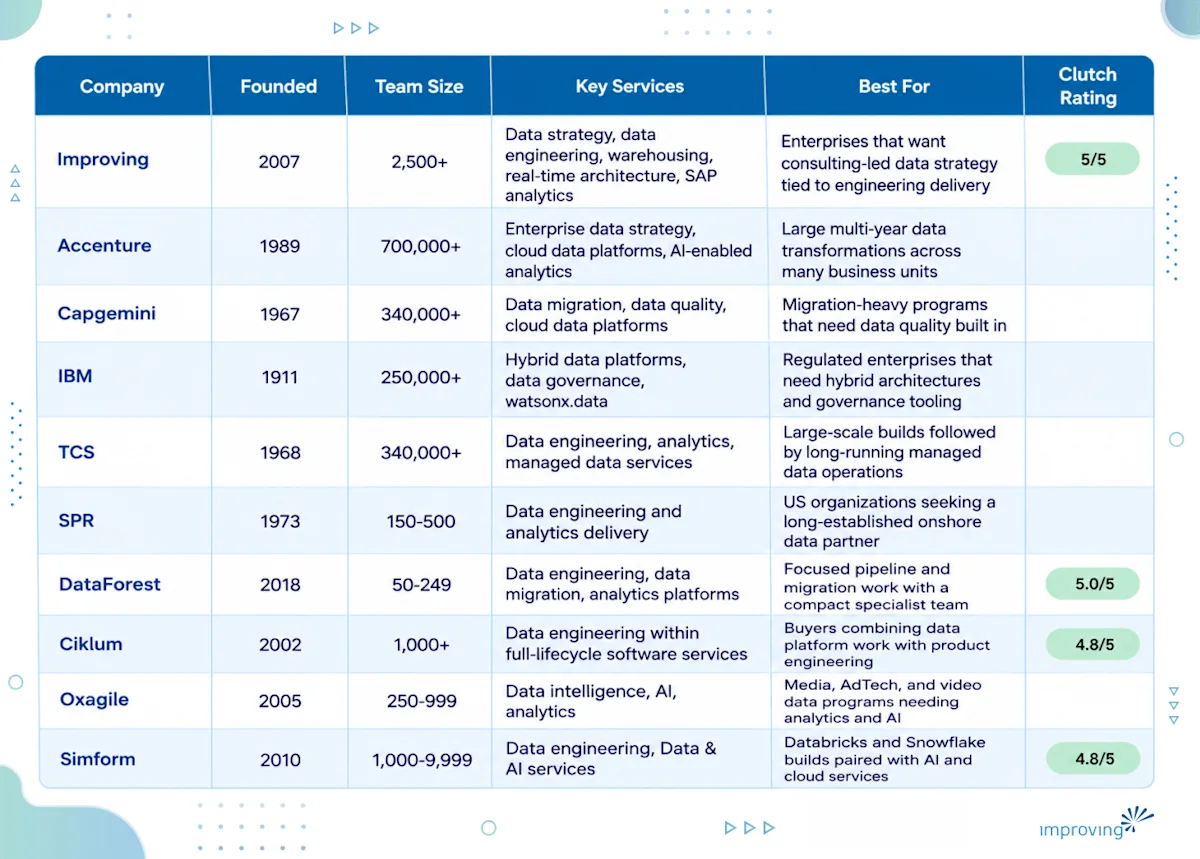
Top 10 Modern Data Companies
1. Improving
Improving Enterprises delivers modern data platforms through a consulting-led and engineering-led model, with a platform-agnostic stance across Snowflake, Confluent, Databricks, and the AWS, Azure, and Google Cloud data stacks. Its Modern Data practice covers enterprise data strategy, data engineering, data warehousing, event-driven architecture, and SAP analytics, with delivery tied to measurable business outcomes. Improving holds Confluent Systems Integrator status and Snowflake Elite Services Partner status, alongside data engineering credentials from AWS, Google Cloud, and Microsoft Azure.
Why Is Improving the Best Modern Data Partner?
Improving pairs consulting-led data strategy with engineering-led delivery, so platform decisions stay connected to business outcomes from the first workshop. Its hybrid delivery model and governance structure keep modern data programs measurable across the full lifecycle.
NPS 90+: among the highest in modern enterprise technology services.
7.5-year average partnership length: built around long-term relationships, not one-off projects.
Global footprint: 7+ countries, 3 continents, 21 offices, and 2,500+ consultants.
Key verticals: energy and utilities, healthcare, forestry, and retail.
Platform stack: Snowflake, Confluent, Databricks, AWS, Azure, and Google Cloud.
Relevant strengths: Confluent and Snowflake partnerships, real-time data processing, and SAP Analytics Cloud implementation.
Global Delivery Access
Modern Data engagements draw on Improving's Toronto office, which led the Sotheby's and Canfor work featured in its case studies. Teams can be assembled across the firm's office network, so multi-region data estates run under one set of engineering standards.
Proven Track Record
Named clients include Sotheby's, Canfor, Zipnosis, and Nutrien. Zipnosis, a Minneapolis-based virtual care platform, had to move its legacy database to AWS during a COVID-19 surge that pushed telehealth web requests from 5,000 to 40,000 per minute, while staying within HIPAA, HITRUST, and SOC 2 requirements. Improving delivered a Terraform and Amazon EKS platform and a custom encrypted streaming service that migrated the data to Amazon Aurora Postgres in two waves, resulting in a migration timeline cut from six months to three months.
Looking to achieve similar results with a trusted partner? Connect with our Modern Data experts to explore how we can accelerate your data platform roadmap.
Strategic Advantage
Improving's Modern Data practice combines Confluent Systems Integrator and Snowflake Elite Services Partner status with AWS, Google Cloud, and Azure data engineering credentials. That combination lets streaming, warehousing, and analytics be designed as one platform rather than three separate vendor projects. Verified engagements with Global 1000 organizations in energy, healthcare, and retail back that approach with measurable delivery.
2. Accenture
Large organizations turn to Accenture for enterprise data strategy, cloud data platforms, and AI-enabled analytics. Much of its Modern Data work centers on migration, governance, and analytics modernization across industries.
Quick Facts
Headquartered: Dublin, Ireland
Team Size: 700,000+
Key verticals: Financial services, health, public service, communications, and products
Key platforms: Azure, AWS, Google Cloud, Snowflake, and Databricks
Relevant strengths: Large-scale transformation programs and broad industry coverage
Why Consider Accenture? One firm can carry a multi-year data transformation from strategy through platform build and managed operations.
Talent Pool Access: With roughly 780,000 to 830,000 people, Accenture can staff specialized data engineering roles at a scale few firms match.
Proven Track Record: Accenture has documented cloud data platform migrations, including an infrastructure data platform moved to Azure Cloud Data Services and a Databricks-based cloud data migration offering.
3. Capgemini
Capgemini's 2024 acquisition of Syniti added data quality and migration capabilities to a practice that already covers cloud data platforms and AI.
Quick Facts
Headquartered: Paris, France
Team Size: 340,000+
Key verticals: Financial services, automotive, consumer products, energy, and public sector
Key platforms: AWS, Azure, and Google Cloud data services
Relevant strengths: Data migration and quality tooling, following the Syniti acquisition
Why Consider Capgemini? Programs that combine data migration, data quality, and platform build can run under a single delivery team.
Talent Pool Access: Across regions, a workforce of roughly 340,000 to 420,000 people absorbs high-volume migration and engineering work.
Proven Track Record: Syniti, which Capgemini acquired in 2024, reports that Mitre 10 achieved a 96% improvement in SAP S/4HANA data migration accuracy while consolidating data from 84 stores. The figure is vendor-reported and has not been confirmed as a Capgemini-delivered engagement.
4. IBM
Hybrid cloud infrastructure, consulting, and the watsonx.data platform come together in IBM's enterprise data offering. Regulated enterprises that need hybrid deployments and strong governance are its most natural fit.
Quick Facts
Headquartered: Armonk, New York
Team Size: 250,000+
Key verticals: Banking, insurance, healthcare, government, and telecommunications
Key platforms: watsonx.data, Db2, Red Hat OpenShift, AWS, and Azure
Relevant strengths: Hybrid cloud architecture and governance tooling
Why Consider IBM? A hybrid data architecture with governance tooling built in is the main reason to shortlist IBM.
Talent Pool Access: Roughly 250,000 to 300,000 people, including a large consulting bench, give IBM capacity for multi-year modernization work.
Proven Track Record: IBM's published case study reports that Cogniware, a software company, achieved a 60% improvement in the time it took to process data from varied sources and formats. IBM also positions watsonx.data as a governed lakehouse option for AI workloads.
5. TCS
Data engineering, analytics, and managed data services operate at high scale within Tata Consultancy Services. Its offshore delivery capacity suits platform builds that hand off into long-running managed operations.
Quick Facts
Headquartered: Mumbai, India
Team Size: 340,000+
Key verticals: Banking, financial services, retail, manufacturing, and telecommunications
Key platforms: AWS, Azure, Google Cloud, Snowflake, and Databricks
Relevant strengths: Managed data services at scale
Why Consider TCS? A buyer that wants one engineering team to build a data platform and then operate it for years will find TCS's model well suited.
Talent Pool Access: Reported headcount between roughly 340,000 and 600,000 gives large data programs deep bench capacity.
Proven Track Record: TCS built an open banking data platform for Great Southern Bank, an Australian bank, on public cloud using cloud-native services, and the program won the Celent Model Bank 2023 award for Open Banking. TCS also manages the bank's core banking platform, in a partnership that has lasted more than 13 years.
6. SPR
Founded in 1973, SPR is a technology consultancy delivering data engineering, analytics, and application modernization for mid-market and enterprise clients. Andersen Group (ANDG) acquired SPR in October 2026, and SPR now operates as part of Andersen's global consulting practice.
Quick Facts
Headquartered: Chicago, Illinois
Team Size: 150-500
Key verticals: Insurance, energy, staffing, and membership organizations
Key platforms: Power BI, Microsoft Azure, and AWS
Relevant strengths: Long operating history and a US-based delivery model
Why Consider SPR? US organizations that want onshore data modernization from an established firm should put SPR on the shortlist.
Talent Pool Access: Onshore, client-embedded delivery for data programs rests on a US-based team of roughly 150 to 500 people.
Proven Track Record: SPR helped Motista, a consultancy, build a stronger data foundation, and the client credited the team with focusing on business goals. SPR has also published case studies on applied data science for a retail client and on managing complex engagements for a global information and measurement firm.
7. DataForest
Data pipelines, migration, and analytics platforms are the core of DataForest's work for mid-sized and enterprise clients. Its Clutch reviews point to consistently strong results across that data engineering work.
Quick Facts
Headquartered: Kyiv, Ukraine
Team Size: 50-249
Key verticals: Healthcare, manufacturing, and analytics-driven enterprises
Key platforms: Cloud data warehouses, ETL (extract, transform, load) and ELT (extract, load, transform) pipelines, and analytics platforms
Relevant strengths: Focused data engineering and migration capacity, with a second location in Tallinn, Estonia
Why Consider DataForest? Buyers who need focused pipeline and migration capacity, backed by strong client reviews, should consider DataForest.
Talent Pool Access: A compact team of roughly 50 to 249 people, with a second location in Tallinn, keeps DataForest's engineering group specialized.
Proven Track Record: DataForest's published case study for Sagis Diagnostics, a Houston medical lab, describes a Databricks migration that cut compute costs by roughly 50% through a pay-per-use architecture, with automated lineage and monitoring dashboards built in.
8. Ciklum
Data engineering sits alongside application development, testing, and infrastructure automation in Ciklum's full-lifecycle services. Its teams often connect data platform builds to broader product work.
Quick Facts
Headquartered: London, United Kingdom
Team Size: 1,000+
Key verticals: Financial services, healthcare, retail, and technology
Key platforms: AWS, Azure, Google Cloud, and streaming tools
Relevant strengths: Full-lifecycle engineering and distributed teams
Why Consider Ciklum? Teams that want data pipelines and product features built by the same partner will find its full-lifecycle model useful.
Talent Pool Access: Estimates of Ciklum's engineering base range from about 1,100 to 4,000 people, giving buyers a large distributed bench.
Proven Track Record: Ciklum built a real-time analytics dashboard for a Big Four professional services firm, which loaded more than three times faster than the client's requirement. The engagement was later extended with further development and support work.
9. Oxagile
Data intelligence, AI, and analytics form one practice within Oxagile's software engineering work, often alongside AdTech, video streaming, and EdTech engagements.
Quick Facts
Headquartered: New York, New York
Team Size: 250-999
Key verticals: AdTech, media and video streaming, and EdTech
Key platforms: Analytics and AI tooling delivered on client cloud environments
Relevant strengths: Data intelligence and AI, with analytics platform redesign experience
Why Consider Oxagile? Media, AdTech, and video businesses that need analytics and AI from one firm may find Oxagile a natural match.
Talent Pool Access: A team of roughly 1000 people, with a Warsaw office, lets Oxagile offer nearshore European capacity.
Proven Track Record: Oxagile holds Clutch Top Software and Clutch Champion designations, and its client reviews include analytics platform redesign and business intelligence work.
10. Simform
Simform pairs data engineering and Data & AI services with partnerships in Databricks and Snowflake. Buyers who want data platform work bundled with product engineering and cloud services tend to shortlist it.
Quick Facts
Headquartered: Orlando, Florida
Team Size: 1,000-9,999
Key platforms: Databricks, Snowflake, and major cloud providers
Relevant strengths: Databricks and Snowflake partnerships
Why Consider Simform? For a single engagement covering Databricks or Snowflake data engineering, AI, and cloud services, Simform is worth a look.
Talent Pool Access: Simform's team of roughly 1,000 to 9,999 people gives multi-phase data programs room to scale.
Proven Track Record: Simform reports that a data platform it built for an automotive client materially improved data accuracy, and that an EV charging client's billing cycles were shortened. Its Databricks partnership supports this data engineering delivery.
Building a Long-Term Modern Data Partnership
Modern data platforms create value only when they stay reliable, governed, and tied to the decisions the business makes. A partner should be judged on whether it can prove those credentials on platforms like yours. The strongest partners bring platform depth, a delivery model your team can sustain, and a clear plan for handing the platform over with the skills to run it. We see that combination work in practice. Our Modern Data practice helped Zipnosis cut a cloud migration timeline from six months to three months while keeping HIPAA and HITRUST requirements in place. We would welcome the chance to do the same for your organization, starting with a review of your current data estate and the decisions it needs to support. Explore our Modern Data services or schedule a consultation to see how we would approach your roadmap.
Frequently Asked Questions
1) What does a Modern Data company do?
A Modern Data company designs and builds cloud data platforms that centralize, process, and govern an organization's data. Typical work includes data strategy, pipeline engineering, warehouse or lakehouse build-outs, and analytics enablement. Many firms also operate the platform after launch.
2) How long does a Modern Data platform project take?
Focused projects, such as a single pipeline migration or one analytics domain, often run a few months. Enterprise-wide programs that modernize several systems commonly take a year or more. Timelines depend on data volume, source system complexity, and governance requirements.
3) Should we choose a Snowflake or Databricks platform?
The answer depends on your workloads, team skills, and existing investments. Snowflake is often chosen for SQL-centric analytics and data sharing, while Databricks is often chosen for engineering-heavy workloads and machine learning. A good partner evaluates both against your roadmap before recommending one.
4) What is the difference between a data warehouse and a data lakehouse?
A data warehouse stores structured data optimized for reporting and SQL analytics. A data lakehouse combines low-cost storage for raw and semi-structured data with the performance and governance features of a warehouse. Many organizations use lakehouses to support analytics and AI workloads on one platform.
5) How do we measure whether a Modern Data investment is working?
Track pipeline reliability, data freshness, the share of trusted datasets used in decisions, and time to insight for new business questions. Define these metrics before the engagement starts so the partner and your team share a baseline. Review them quarterly after go-live.
6) Do we need a partner if we already have an internal data team?
Many organizations bring in a partner for specialized work, such as a migration, a real-time architecture, or a governance program, while their internal team owns the long-term platform. The partner's most valuable contribution is often knowledge transfer that leaves your team able to operate the platform independently.