


October 27, 2026 | 11 Minute Read
GenAI has moved from research demos to boardroom priority in a remarkably short time. Companies are racing to integrate LLMs into customer support, search, knowledge management, and internal workflows. But while adoption is accelerating, the engineering practices needed to operate these systems reliably are struggling to keep pace.
The challenge is that getting a GenAI application to work in a demo is very different from running it reliably in production. A retrieval-augmented generation (RAG) pipeline can quietly return irrelevant context. A prompt change or model update can degrade response quality without triggering a traditional test failure. An application that performs well with a handful of test queries can produce inconsistent answers under real-world conditions, while token consumption and inference costs grow unpredictably with usage. Without systematic evaluation and monitoring, these problems can go undetected until they affect users or business outcomes.
The missing piece is the engineering discipline required to take a GenAI application from a working prototype to a production-grade system. Making an LLM call is only the starting point. Teams need ways to evaluate output quality, detect regressions, investigate failures, monitor costs, and maintain control as their applications evolve.
In this blog post, we'll explore the challenges of running GenAI applications in production and the engineering practices that help address them, from evaluating LLM outputs and monitoring system behavior to managing changes and maintaining reliability over time.
Why GenAI Systems Fail in Production
Understanding the AI application stack
An LLM is only one component of a larger application. Production failures can originate anywhere in the stack, from stale retrieval data to orchestration bugs or infrastructure issues. When teams treat the model as the entire application, these problems are often misdiagnosed as model quality issues. A typical GenAI application consists of the following layers:
Application/UX layer: How requests enter the system and how responses are rendered to end users
Orchestration layer: The framework sequencing calls across the other layers
Retrieval layer: Search and ranking over the knowledge base that grounds the response
Embedding layer: The vectors representing documents and queries for similarity search
Vector database: Storage and indexing, with its own consistency and freshness behavior
Tools/external APIs: Functions and services the model calls to take action or fetch data
LLM layer: The model itself, hosted or API-based
Infrastructure layer: Compute, networking, and hosting underneath everything above
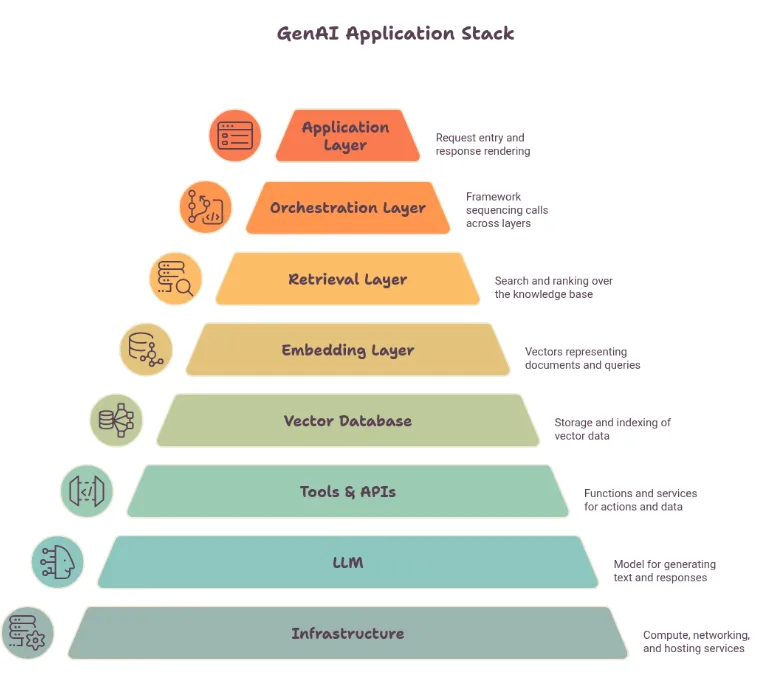
Each layer has its own failure surface, and a failure rarely stays contained:
Retrieval: Stale documents can lead to hallucinated answers even when the model itself is working as expected.
Orchestration: A routing bug can send a query to the wrong tool or workflow, producing a confident but incorrect response that looks like a model quality issue.
Vector index: If the index falls behind, retrieval quality can quietly degrade for hours before anyone notices.
Infrastructure: Resource constraints or network failures can increase latency or make services unavailable.
These failures illustrate why validating the model alone isn't enough. A GenAI application needs to be evaluated and monitored as a complete system, including the components that supply context, coordinate execution, and deliver responses.
This is where MLOps and LLMOps become important.
MLOps provides practices for versioning, deploying, monitoring, and managing machine learning systems throughout their lifecycle.
LLMOps builds on these practices to address the additional challenges of LLM-powered applications, including prompt versioning, output quality evaluation, RAG pipeline reliability, hallucination detection, and token and inference cost management.
Together, these practices help teams track changes across the stack, detect regressions, investigate failures, and maintain consistent behavior as models, prompts, data, and dependencies evolve. Production readiness is a property of the entire application stack, not just the model.
Operational challenges of running GenAI at scale
A GenAI application introduces a challenge traditional software rarely faces - the same input can produce different outputs across calls.
For example, ask an AI agent to investigate a failed deployment, and it might check logs first on one run and resource usage or configuration changes on another. The outcome may be similar, but the path can vary each time, making testing and troubleshooting harder. That non-determinism compounds with a handful of other failure modes:
Prompt drift: A small change to a prompt can alter the output in many ways. For example, changing the instructions to make responses shorter might also cause the model to skip information another part of the application depends on.
Model updates: A provider-side model change can affect an application without any code being changed. For example, if an application is built and tuned around Claude Sonnet 4.6 and the provider retires or replaces that version, the newer model may behave differently enough to require retesting and tuning.
Retrieval degradation: As the knowledge base changes, retrieval quality can decline if the content or embeddings are no longer aligned. For example, adding large amounts of new documentation without re-indexing it properly can cause the system to surface older or less relevant information.
Data freshness: The system can give a confident answer based on information that is no longer current. For example, an internal AI assistant could recommend a deployment process that was changed weeks ago because its knowledge source hasn't been updated.
Latency and cost: A single request can trigger several steps, each adding time and cost. For example, a request might involve an embedding call, vector search, reranking, and multiple LLM calls before the user sees a response.
External dependency failures: A failure outside your application can still become a production incident. For example, a model provider outage or vector database timeout can cause an otherwise healthy application to fail.
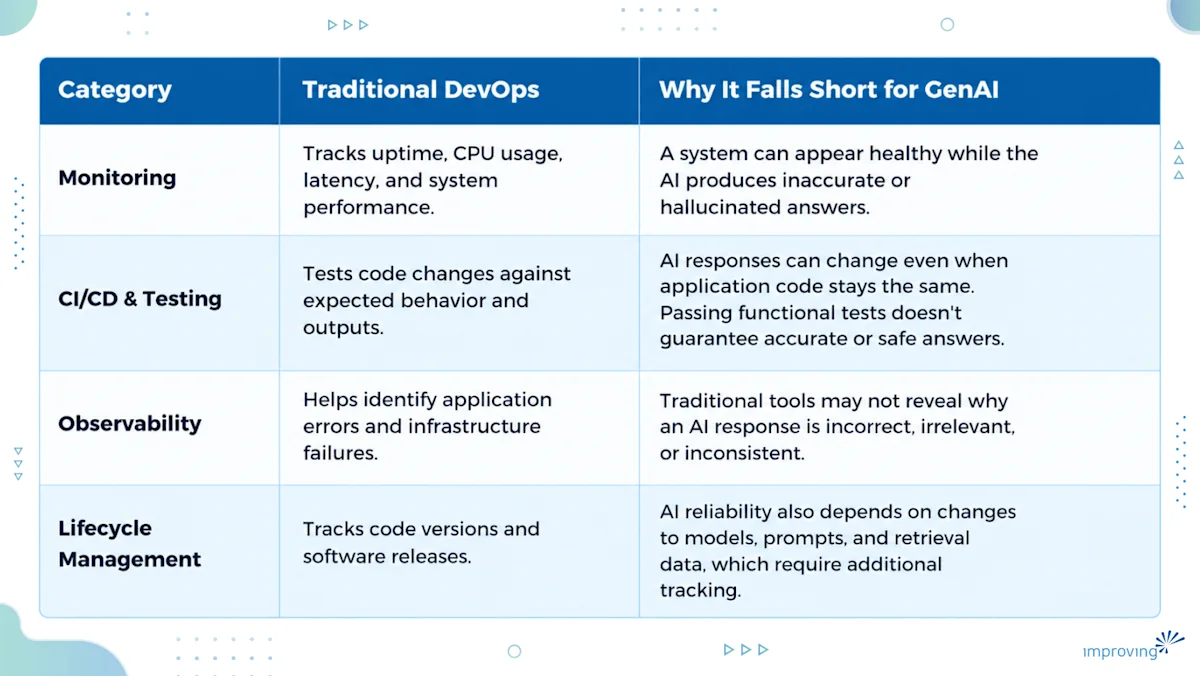
These challenges are hard to catch with traditional monitoring because they don't throw errors.
A degraded retrieval pipeline doesn't return a 500, it returns a 200 with a worse answer.
Infrastructure monitoring is built to detect availability and performance problems, not quality problems, and quality is exactly where GenAI systems fail. Effective LLM monitoring has to track answer quality, not just uptime.
Why traditional DevOps falls short
The reasons traditional DevOps falls short are:
Hidden Cost of Skipping MLOps
Reliability and engineering costs
Without MLOps practices such as versioning, continuous evaluation, and monitoring, teams often end up dealing with production problems reactively, spending more engineering time diagnosing and fixing issues.
Production incidents traced back to an unvalidated prompt change, a retrieval pipeline serving stale documents, or an unannounced model regression
Debugging that becomes a manual, time-consuming guessing game, since there's no reliable way to confirm which layer caused a bad output, or that a fix actually worked
Technical debt in the form of prompts nobody remembers the reasoning behind, and retrieval configurations tuned by trial and error rather than measurement
Each change carries more risk than it should, because there is no reproducible baseline to test against.
Business, operational, and financial impact
The engineering costs translate directly into business costs:
Inference spend escalates quietly with no visibility into token usage per feature or prompt version, often surfacing only when the monthly bill arrives
Resource utilization suffers from over-provisioned compute or redundant model calls that go unnoticed
Developer productivity drops as teams become reluctant to change prompts or retrieval logic without a fast way to confirm nothing else broke
Customer trust erodes when an AI feature behaves inconsistently or degrades without warning, and it takes far longer to win back than it took to lose
These costs often go unnoticed until they show up in cloud bills, delayed releases, or customer complaints. They stem from running a probabilistic, multi-layer system without the evaluation, monitoring, and cost controls needed to manage it effectively. What starts as a shortcut during development can become an expensive problem in production.
Production-Grade MLOps for Reliable GenAI
Managing the complete AI lifecycle
The starting point for reliability is managing the complete AI lifecycle, from the data and knowledge sources that feed the system to the models, prompts, retrieval configuration, evaluation, and production monitoring.
Data and knowledge preparation: Source data needs to be collected, cleaned, validated, and kept current before it becomes part of the system's knowledge base.
Versioning: Prompts, datasets, embeddings, evaluation sets, and models all need change history and rollback, just like application code.
Experiment tracking: Results need to be tied to the exact combination of artifact versions that produced them, so experiments remain comparable and reproducible.
Deployment pipelines: Changes to prompts, models, and retrieval configuration should pass through automated evaluation before reaching production.
These stages build on the fundamentals of MLOps covered in our earlier post, extended here to account for the additional artifacts and failure modes introduced by GenAI.
Continuous evaluation and AI observability
AI lifecycle management gives a team control over what's deployed. Continuous evaluation tells them whether what's deployed is actually good. That means measuring the dimensions that determine whether a system is useful, not just whether it returns a valid response:
Hallucination rate
Retrieval quality
Groundedness against retrieved context
Relevance to the user's query
Latency and cost per interaction
These metrics only become actionable when tied to end-to-end tracing across the full request path, from prompt through retrieval to model response. Without that trace, a regression can be detected but not diagnosed. With it, a groundedness drop traces back to a specific retrieval change, turning a vague complaint into a fixable defect.
Governance, security, and continuous improvement
Guardrails, policy enforcement, and compliance controls need to sit in the request path itself, filtering unsafe inputs and outputs such as prompt injection attempts and sensitive data leakage, rather than being layered on after problems surface. They should also map to the organization's security baseline. At Improving, that means SOC 2 Type II controls, with alignment to frameworks like NIST CSF and CIS Controls.
None of this is static. Human feedback and automated evaluation both feed back into the system on an ongoing basis, so flagged responses and low-scoring evaluation runs become inputs to the next round of changes. That closed loop is what turns MLOps from a one-time setup into a continuous improvement cycle.
Best Practices for Building Production-Ready GenAI Systems
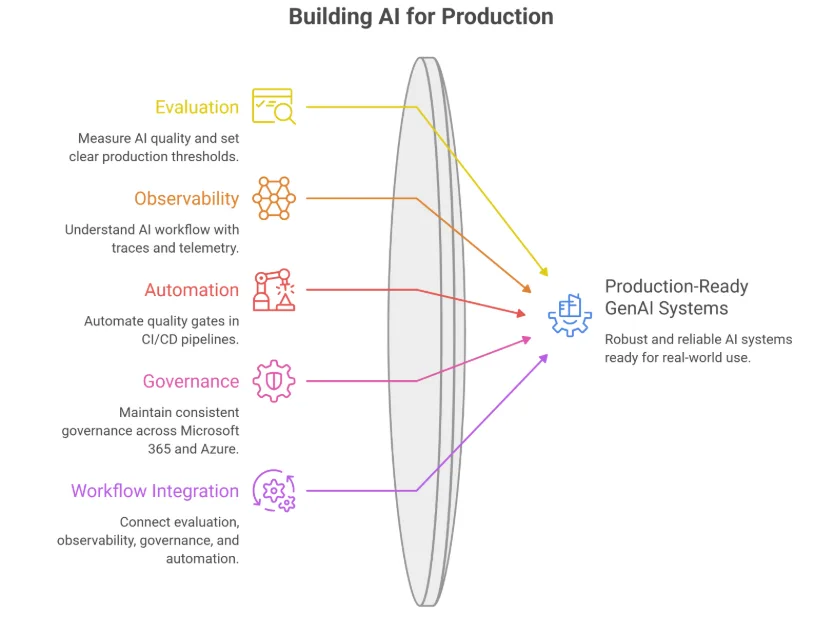
Moving from a working prototype to a production-ready system is an engineering effort. Before taking on real traffic, treat the AI system like any other production workload:
Make evaluation part of the deployment process: Use the evaluation capabilities in Microsoft Foundry (formerly Azure AI Foundry) to measure quality and set clear thresholds before a change reaches production.
Build observability from the start: Route traces and telemetry through Azure Monitor and Application Insights so teams can understand what is happening across the application and AI workflow. Designing applications to be observable from day one is covered in our post on observability-driven development.
Automate quality gates in CI/CD: Extend the delivery process already in place for the rest of the application by running evaluations through GitHub Actions or Azure Pipelines.
Keep governance consistent: Use the governance and policy controls already established across the Microsoft 365 and Azure environment instead of creating a separate governance process for GenAI.
Treat these as one workflow: Evaluation, observability, governance, and automation work best when they are connected and every change passes through the same production readiness process.
For a broader view of running AI workloads on cloud infrastructure, see our guide to AI in the cloud.
MLOps as an Engineering Discipline for Enterprise AI
Production-grade GenAI is achieved by building reliable operational systems around whichever model is in use, so the system's behavior is measured, traceable, and improvable regardless of what sits at its center.
MLOps is what makes that possible: the discipline that turns GenAI from experimental software, impressive in a demo and fragile in production, into dependable production infrastructure an enterprise can stake a customer-facing process on.
Organizations that invest early in evaluation, observability, governance, and continuous improvement tend to move faster and with less risk, because a team that can measure the impact of a change can ship it with confidence instead of caution. That combination, lower risk and higher velocity, is the actual business case for MLOps.
If you're looking to build more reliable AI systems, explore how Improving can help your team take GenAI applications from prototype to production.