


October 19, 2026 | 9 Minute Read
AI-assisted software development is moving quickly, and the opportunity is a better path from idea to usable outcome. Spec-driven development builds that path by making assumptions visible, reducing rework, and giving people a way to reason through complex work before agents begin writing code.
Spec-driven development is an approach where teams write and review a specification first, and agents and developers build from that shared source of truth. That is why I was proud to serve as a technical reviewer for Spec-Driven Development with BMAD: Master Agentic Workflows Using Cursor, BMAD, and Context Engineering by Marlon Vidal Ferreria, published by Packt.
The book captures a shift many teams are beginning to feel: agents are most useful when they operate inside a clear system of intent, context, roles, and feedback.
Gap Between Prompts and Products
Early AI coding workflows often start with a simple premise. Give the model a good prompt, provide some requirements, and ask it to build something.
That can work and I have seen it work.
I ran an experiment using a set of raw requirements to build a multimodal neural-network project with GitHub Copilot. It was an ambitious holiday-weekend effort, involving plenty of context loading, iteration, and what I would generously call “token maxing.” The result was real, functional, and worth being proud of.
But it also made one thing clear. A requirements document is not a development system.
A raw PDF or Markdown file can describe what needs to be built. It does not necessarily help a team or an individual developer work through the questions that determine whether the solution will be useful:
What problem are we actually solving?
What assumptions are we making?
Which risks should be addressed before implementation begins?
What information does an implementation agent need?
How should architecture, user experience, testing, and delivery influence one another?
How do we keep fast AI output from turning into fast rework?
The value is that the work can become more intentional before any code is produced, and an agent that writes more code is only part of that.
What BMAD Method Changes
I first looked at BMAD after a colleague at Improving, Tim Rayburn, asked whether I had explored it. I spent a weekend with the framework and quickly saw the potential.
BMAD is an AI-assisted software development method that adds structured planning, coding, and review skills to AI coding tools, helping you turn ideas into working software while keeping you in charge of decisions.
BMAD brings structure to agentic work through role-based personas, guided workflows, reusable artifacts, and a spec-driven approach to planning and execution. The BMAD framework encourages users to engage different perspectives: product thinking, analysis, architecture, development, testing, and more.
That matters because product development is not a single activity.
A developer can begin coding from a vague description. An agent can do the same thing faster. Neither approach guarantees that the team has framed the problem well, considered tradeoffs, or established what “done” means.
BMAD makes space for those questions.
The framework supports a more disciplined sequence:
Clarify the problem before reaching for a solution.
Turn ideas into specifications that can be reviewed and challenged.
Use specialized agent perspectives to expose gaps and assumptions.
Create artifacts that remain useful throughout delivery.
Move into implementation with a stronger shared understanding.
Use feedback to refine the work before generating more output.
Process like this matters because agents accelerate whatever system they are given, including a confused one.
Human element still matters
There is a temptation to frame agentic development as a replacement story.
The agent replaces the analyst.
The agent replaces the product manager.
The agent replaces the architect.
The agent replaces the developer.
That is not the most useful way to think about it.
The better mental model is that AI agents can make expertise more available, repeatable, and accessible at the point of work. They can help a solo builder think through a problem from multiple angles. They can help an experienced team turn tacit knowledge into a repeatable workflow. They can help organizations create a more durable connection between strategy, planning, implementation, and validation.
But agents do not remove the need for judgment.
Someone still has to decide whether the right problem is being solved
Someone must recognize when a generated answer is technically plausible but operationally wrong
Someone must weigh constraints that do not fit neatly into a prompt: organizational politics, regulatory obligations, customer trust, cost, maintainability, and timing
This is especially important for leaders adopting AI development tools. The question is, “How can we help people make better decisions and reduce avoidable work?”
AI should raise the quality of the conversation before it raises the volume of the output.
Why specification is becoming strategic
For years, many organizations treated requirements as paperwork standing between an idea and the “real work” of development. In an agentic environment, that assumption becomes costly.
When code can be generated quickly, ambiguity becomes more expensive, not less.
An unclear specification can now produce a much larger volume of incorrect implementation in much less time. Teams may feel productive because repositories are changing, pull requests are appearing, and demos are being created. Yet they can still be moving rapidly in the wrong direction.
Specification-driven development is about creating enough shared understanding to make the next decision responsibly.
A useful specification should help answer questions such as:
What outcome should this capability create for users or the business?
What is in scope, and what is intentionally out of scope?
What decisions have already been made?
What decisions remain open?
What constraints must the implementation respect?
What acceptance criteria will tell us if the work is successful?
What risks are serious enough to investigate before building?
This is where spec-driven development becomes a way to improve the quality of organizational thinking.
Real-world Uses Go Beyond Software Development
My experience with BMAD has not been limited to code repositories. I have used the framework across nearly a dozen repositories over the past several months. I have also used its structure for planning work outside traditional software delivery, including hackathon preparation and a client engagement where the need was to organize deliverables, identify risks, perform feasibility analysis, and build a coherent plan. BMAD is useful because it is a structured thinking tool. The same practices that help a team create a sound technical design can help a consultant frame a client engagement. They can help a product leader test assumptions before committing funding. They can help a hackathon team avoid spending most of its limited time debating what to build. They can help a solo creator turn a rough idea into a sequence of decisions and artifacts that others can understand. The pattern is transferable:
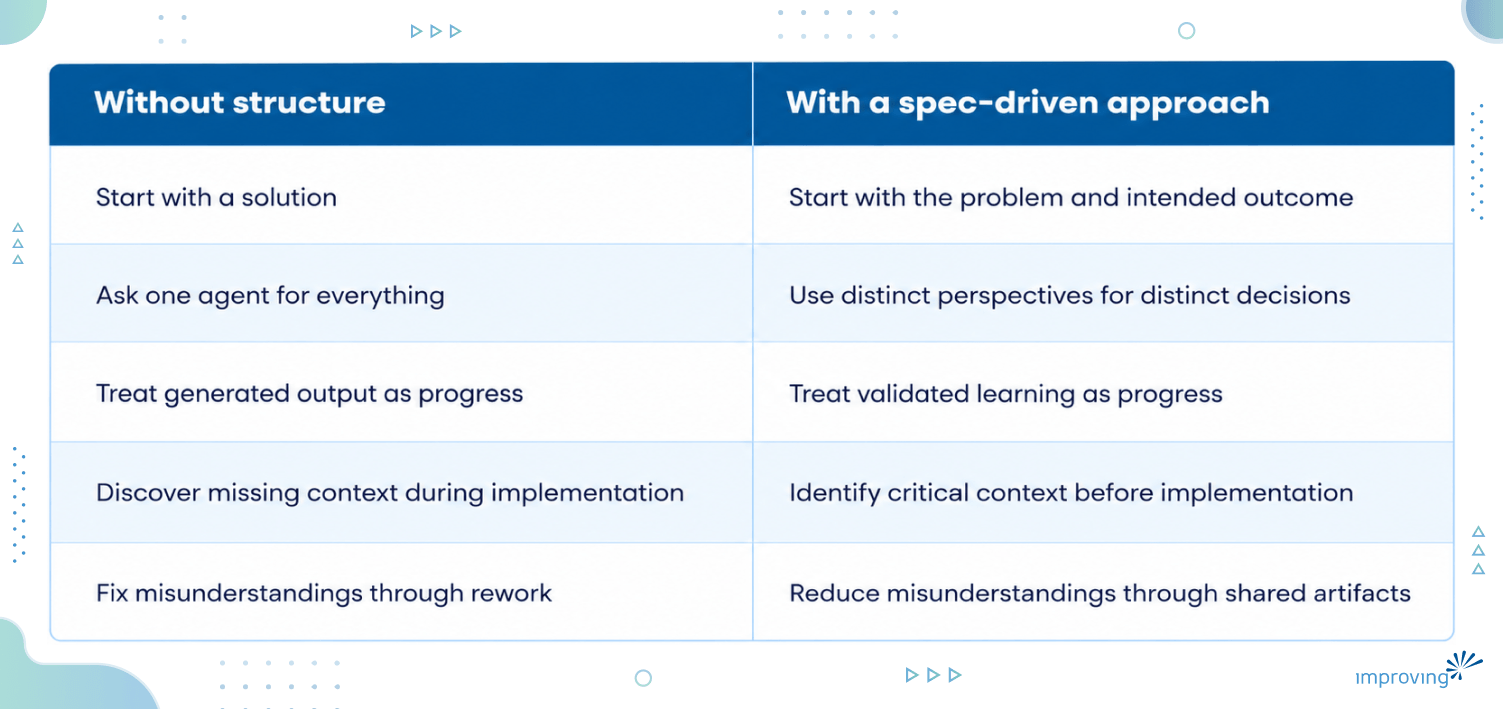
BMAD vs unstructured AI development
The difference between BMAD and unstructured AI development (vibe coding) isn’t just how AI generates code, but how teams define problems, make decisions, and validate outcomes.
A Better Starting Point for Teams
Teams interested in AI-assisted delivery can start small and resist the urge to adopt every new framework at once.
Start with an experiment.
Choose a bounded problem. Use a spec-driven workflow to define the outcome, document constraints, identify risks, and create an initial architecture or implementation plan. Then compare that experience with a more prompt-first approach.
Pay attention to more than code quality. Ask:
Did the team reach clarity faster?
Did people surface disagreements earlier?
Were implementation decisions easier to explain?
Did the work create reusable context for the next person?
Did the output require less rework?
Did the team feel more in control of the process?
Those questions matter more than whether an agent generated a feature in 10 minutes instead of 30. You can view the BMAD method on GitHub. A healthy AI-enabled workflow makes capable people more effective and keeps them close enough to the work to understand what the machine generated.
Why This Book Mattered to Me
Several years ago, I was approached about coauthoring a book on Scrum. I thought about it for a long time, considered the opportunity, and ultimately did not move forward.
The timing was not right. I was still working out where I wanted my professional voice to land, particularly in technical publishing. I wanted to be certain that anything I attached my name to would have practical value and enough staying power to be useful beyond a moment in time.
This opportunity was different.
By the time Packt approached me about serving as a technical reviewer, I had already spent meaningful time with BMAD in both technical and planning work, and I had seen the difference between loosely structured AI-assisted development and a workflow built to make context, intent, and decisions explicit.
Reviewing the book was a chance to contribute from that practical perspective.
My focus went beyond technical correctness to reader understanding, applicability, and longevity. Could someone new to BMAD understand why the method exists? Could they translate the concepts into their own work? Would the book help them use agentic workflows with more discipline rather than simply more enthusiasm?
I believe it does.
The book is especially valuable for people who see the promise of agentic development but are unsure where to begin. It offers a structured starting point for exploring how specifications, context engineering, and role-based agents can work together.
The Opportunity Ahead
AI is changing software development, but the lasting impact will not come from faster code generation alone. It will come from:
teams that learn how to combine human judgment with agent capability.
organizations that treat context as an asset rather than a nuisance.
leaders who recognize that reducing rework often begins with improving the conversation before the build begins.
That is why spec-driven development deserves attention.
It gives teams a practical way to move beyond “ask the AI to build it” toward a more durable model:
Define the problem
Make decisions visible
Create useful context
Use specialized perspectives
Validate along the way
The technology will continue to evolve. The specific tools, agents, models, and interfaces will change. But the underlying need will remain the same:
Build the right thing with the least unnecessary rework.
For practitioners who want to explore that idea in more depth, Spec-Driven Development with BMAD offers a grounded place to start. When the next step is making spec-driven workflows repeatable across a real delivery team, our AI experts at Improving can help.