

October 29, 2026 | 7 Minute Read
Someone builds one AI training curriculum for employees and rolls it out to the whole company. Engagement looks strong in week one and collapses by week six, and leadership spends the next two quarters wondering why.
I watched this happen at a Fortune 500 client. The course was well made, but it was made for an imaginary average employee. "AI training" turned out to be several different skills under one name. An AI adoption strategy that treats training as one deliverable fails because what an engineer needs looks almost nothing like what an executive needs.
Role of AI Training in AI Adoption
An AI adoption strategy is the plan for how an organization moves people, processes, and tools from experimenting with AI to using it in daily work. AI training for employees is the layer where that plan tends to succeed or fail, because it decides who learns what, to what depth, and how anyone knows it worked. Everyone in the company is entrusted with a particular set of tasks, as per their roles and skillset. A role-based AI adoption strategy sets those answers per role instead of per company.
What Goes Wrong Without Role-Based AI Training
Without a role-based design, three things go wrong at once.
Technical staff feel the curriculum is beneath them
Non-technical staff feel they have been handed a developer bootcamp
Nobody knows which track applies to them
Most people do nothing and eventually, the AI training fails. The completion numbers still look fine, which hides the problem until the next planning cycle.
How to Achieve Role Based AI Adoption
1. Separate Literacy from Construction
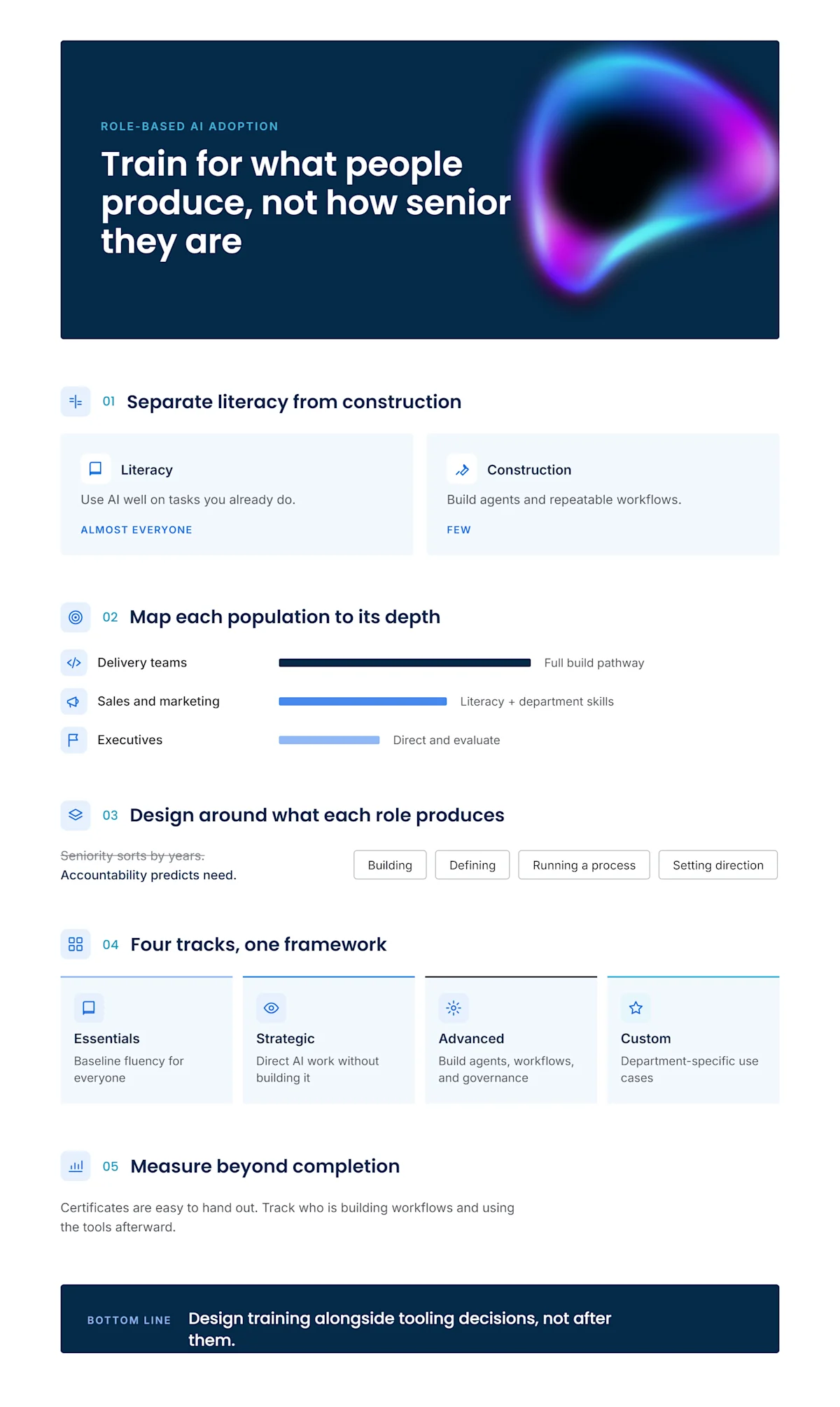
Two skill transitions sit inside every AI training program, and most organizations design for only the first.
Literacy: AI literacy training moves someone from not touching an AI tool to using it competently for tasks they already do. It includes off-the-shelf usage, permission-based, one prompt at a time, and a human controlling every step. Almost everyone needs it. It is teachable in a few hours and is where most of an organization's population should start.
Construction: Moving from using a tool someone else built to building workflows, agents, and repeatable systems around it. This stage covers task agents, defined constraints, governance, audit trails, and a shift from "I used AI to help with this task" to "I built something that does this task with AI doing most of the work." It is not for everyone.
2. Map Each Population to Its Depth
We hit this while designing the communication plan for our own rollout. We kept getting stuck because three populations were being described with one message.
Delivery professionals: They need the full construction pathway, a multi-course sequence that starts with the foundational literacy everyone gets, then specializes in building agentic workflows in their discipline. This group includes developers and the project managers, and business analysts who work alongside them.
Executives: They needed enough exposure to know what ‘stage four’ looks like and enough hands-on time to stop being afraid of the tools. They did not need deep construction skills, because directing and evaluating AI-driven work is a different job than building it.
Sales and marketing: Supporting business teams needed a third profile, closer to literacy plus department-specific specialization than to the engineering pathway.
Describing all three on one slide failed, and the confusion in that room was a preview of what a badly designed rollout creates across a company. A common root cause sits underneath it: training gets bolted onto a rollout after the tooling decisions are made, instead of designed alongside them.
3. Design AI Training Around What Each Role Produces
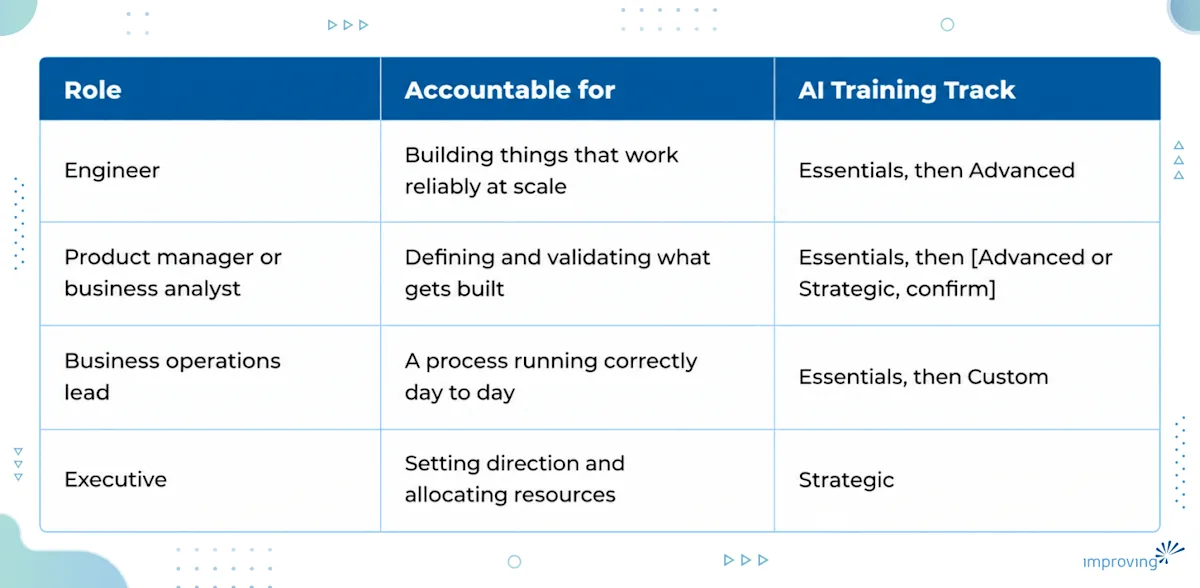
The instinct behind "role-based training" is to tier by seniority: junior gets basic, senior gets advanced. Tiering by seniority sorts people by years of experience. The axis that predicts what someone needs is what they are accountable for producing.
4. Build AI Training Programs for Employees as Four Tracks
This is why we structure Improving's corporate AI training as a four-track AI adoption framework: Essentials, Strategic, Advanced, and Custom.
Essentials: For almost everyone in the organization. It covers the baseline fluency: how the tools work well enough to use them competently, how to evaluate an output instead of trusting it blindly, and what the guardrails are. Every population in our own rollout goes through it first, whatever track they specialize into afterward. For most people, the practical skill it builds is framing a request clearly enough that the tool gives you something usable on the first try.
Strategic: For people who direct AI-driven work without building it, such as executives, product owners, and department leads. It is compressed and hands-on. It gets someone from "I don't touch these tools" to "I can evaluate this work and ask the right questions."
Advanced: For engineers and technical practitioners who build the agents, workflows, and governance infrastructure that make autonomous AI trustworthy. The literacy-to-construction transition happens here, and it takes far more material than a harder version of the beginner's decks.
Custom: For department-specific specialization. Legal's AI use case looks nothing like marketing's, which looks nothing like recruiting's. A program that pretends otherwise recreates the confusion we hit in our own communication plan.
5. Measure Adoption Beyond Completion Rates
The gap between people who complete a course and people who use what they learned is where generic training shows its cost.
Our own internal target was public inside the company: 750 people certified through stage four, with a stretch goal of 1,000. The developer track filled fast enough to keep people on waiting lists almost from the start.
A completion certificate is easy to hand out. Certification that means something requires tracking whether someone is building workflows and using the tools in a measurable way afterward. That number runs lower than the completion number, and the gap traces back to mismatch: a course at the wrong depth for the person's job, delivered anyway because it was the only curriculum on offer.
For help sizing this against your own organization, our AI strategy and roadmap assessment is a starting point. If your pilots are already stalling, our post on why AI pilots fail to scale covers the nearby failure modes.
Is Role-Based AI Training More Expensive?
Yes. Building and staffing four tracks takes more work than building one deck and running it past everyone. But the real alternative to role-based training is not a cheaper curriculum that works. It is one curriculum that reports a high completion number and produces almost no measurable change in how people work, because it was calibrated for nobody's job. Role-based training costs more to build. Generic training costs more to run, for years, in the form of a workforce that completed a course and changed nothing.
Run a Quick Check on Your Own Training
An AI adoption strategy often fails at the training layer before it fails at the technology layer. Organizations design one curriculum for a population that needs several skills at several depths, and those depths follow what each person is accountable for producing. An engineer building autonomous workflows and an executive evaluating them are on different journeys from day one.
Pull the completion numbers from your last AI training push and ask a harder follow-up. Of the people who finished, how many can point to a workflow, prompt, or process they built afterward that they still use today?
If nobody has the second number, you do not yet know whether your training worked. Attendance is the only thing you have measured.
If you can name the role that would fail that test, you already know which track to build first. Send us that role and your last AI training completion numbers, and we will map it to Essentials, Strategic, Advanced, or Custom and show you what to measure afterward. Have a conversation with our AI training team.
FAQ about Role Based AI Adoption
How many training tracks does an organization need?
Match the number to the distinct accountabilities in your organization, not to a fixed count. We use four tracks because our population falls into four groups: almost everyone, direction-setters, builders, and department specialists.
Does everyone need to learn to build AI workflows?
No. Construction suits engineers and technical practitioners. Most employees need literacy, and executives need enough hands-on time to direct and evaluate the work.
How do we measure adoption instead of completion?
Track who is building or using a workflow, prompt, or process afterward, separately from who finished the course. The gap between the two numbers is the one to close.