

November 13, 2026 | 14 Minute Read
Business agility is now a board-level priority, and buyers face a crowded field of firms with overlapping claims. Many organizations adopt a framework and see little change in how decisions get made, which is why partner selection carries real weight. The global enterprise agile transformation services market is projected to grow at a 16.54% compound annual growth rate (CAGR) from 2025 to 2032, according to Kings Research. This guide compares best firms across coaching depth, framework fit, delivery model, and measurable outcomes. It also sets out the criteria that separate a transformation partner from a framework vendor, so enterprise leaders can build a shortlist that fits their scale and goals.
Executive Summary
Business agility is an organization's ability to sense market change and respond quickly, combining leadership behaviors, operating model design, governance, and team practices. Organizations that build this capability shorten time to market, improve delivery predictability, and keep strategy and execution aligned.
Nine firms are profiled side by side, from global consultancies to engineering-led partners and specialist agile firms. Each is assessed against a framework covering leadership coaching depth, framework flexibility, change management capability, delivery model, and measurable outcomes, so buyers can build a shortlist that fits their scale and goals.
Who Is This Guide For?
Chief Operating Officers responsible for operating model design and enterprise performance
Chief Information Officers and CTOs who need agility to extend beyond IT into the wider business
VPs of Transformation leading multi-year change programs across business units
Heads of Agile Centers of Excellence building internal capability and standard practices
Procurement and Sourcing Leads evaluating consulting partners against defined outcomes
Each of these leaders shares the goal of turning agility from a set of team rituals into a repeatable, enterprise-wide capability.
What Is Business Agility & How Does It Work?
Business agility extends agile principles beyond software teams to the whole organization, including funding, governance, leadership, and customer-facing decisions. It replaces annual planning cycles and large batch releases with shorter feedback loops and empowered teams aligned to business outcomes. Consulting partners help organizations design this shift, coach leaders through new ways of working, and build internal capability that lasts beyond the engagement.
Common models and approaches include:
Enterprise agile frameworks such as SAFe, LeSS, and Nexus, which coordinate multiple teams around shared planning and delivery cadences
Executive and leadership coaching that changes how leaders set priorities, measure results, and remove obstacles
Organizational change management that prepares roles, communication, and adoption for new operating models
Business process and value stream redesign that connects agile delivery to funding, portfolio decisions, and customer outcomes
Agile training and certification that builds shared vocabulary and practical skills across teams
Key Advantages of Business Agility
Faster response to market change because shorter planning cycles and incremental funding let the organization act on new information sooner.
Stronger alignment between strategy and execution because business objectives flow into prioritized backlogs and measurable outcomes.
Greater delivery predictability because regular cadences, visible work, and early risk detection reduce surprises for executives and customers.
Higher employee engagement because teams gain ownership over how they work and make decisions closer to the customer.
Lower cost of change because smaller releases and continuous feedback reduce rework and the expense of late-stage defects.
How To Choose the Best Business Agility Partner?
Seven criteria separate firms that change how an organization works from those that only change its vocabulary.
Leadership coaching depth: Confirm that the partner coaches executives as well as delivery teams. Agility stalls when leaders keep setting priorities and measuring results the old way, so coaching at the top is a leading indicator of success.
Framework flexibility: Look for partners who can work across SAFe, Scrum, Kanban, Nexus, and LeSS. A framework-agnostic partner adapts the approach to your operating model and avoids forcing a single methodology.
Change management capability: Ask how the partner plans for role changes, communication, and resistance. Transformations succeed or fail on adoption, and change management is where most programs lose momentum.
Delivery model: Determine whether the firm offers advisory-only engagements, embedded coaches, or full-service delivery. The right model depends on how much capacity and capability your internal teams already have.
Measurable outcomes: Require a baseline and agreed metrics such as lead time, release frequency, and time to value before the engagement begins. Partners that cannot define success in measurable terms rarely deliver it.
Relevant industry experience: Ask for references in your sector. Regulated industries face different governance and reporting requirements, and experience with them shortens the path to approval.
Knowledge transfer: Confirm that the partner builds internal capability through training, coaching, and documented practices so your teams can sustain the change after the engagement ends.
Questions to ask: How will you measure whether our transformation is working after 12 months? Which leaders will coach our executive team, and how much of their time will they commit? How do you adapt frameworks when our portfolio includes both regulated and fast-moving products?
The bottom line: the best partner changes how leaders lead as well as how teams work.
Business Agility Companies Compared
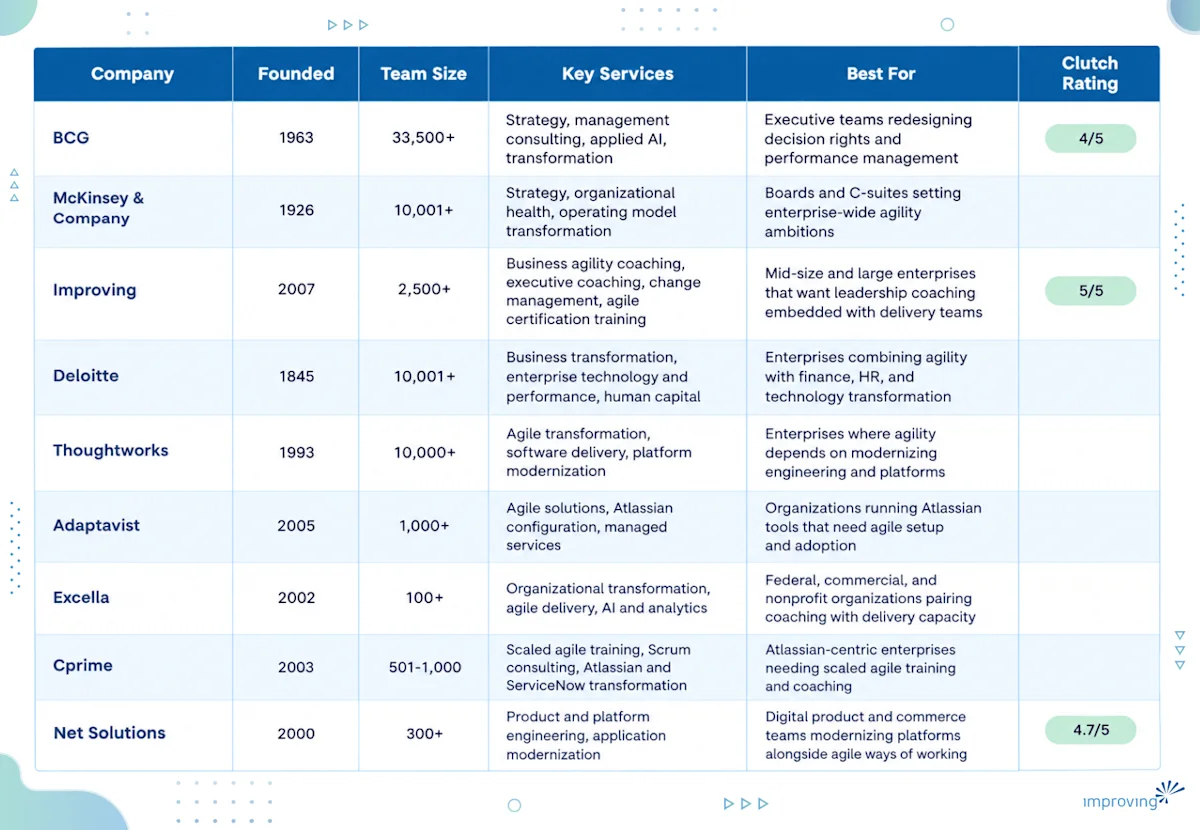
Top 9 Business Agility Companies
1. BCG
Boston Consulting Group is a global management consultancy whose agility work focuses on how executive teams redesign decision rights, governance, and performance management for faster, outcome-driven operations. Its business agility offering sits within a broader strategy, applied AI, and organizational transformation practice.
Quick Facts
Headquartered: Boston, MA, USA
Team Size: 33,500+ global employees
Key verticals: Sixteen industries, including financial institutions, health care, energy, public sector, and retail
Key platforms/technologies: Applied AI and strategy capabilities
Relevant strengths: Executive-level strategy, organizational design, performance transformation
Why Consider BCG? BCG is a strong fit when the agility question starts in the boardroom and needs to be tied to strategy, operating model design, and financial outcomes.
Talent Pool Access: Offices in more than 100 cities across over 50 countries, per bcg.com.
Proven Track Record: BCG reports that its Top 100 clients achieved 12% higher shareholder returns than the S&P 1200, according to bcg.com.
2. McKinsey & Company
McKinsey & Company is a global management consultancy that works with C-suite leaders on strategy, organizational health, and operating model transformation. Its agility work addresses how large organizations change structures, leadership behaviors, and talent practices to move faster.
Quick Facts
Headquartered: New York, NY, USA
Team Size: 10,001+
Key verticals: 22 industry practices, including financial services, healthcare, public sector, energy and materials, and technology, media, and telecommunications, according to mckinsey.com
Key platforms/technologies: McKinsey Solutions (proprietary software and data), with alliances spanning cloud and AI
Relevant strengths: Enterprise strategy, organizational health, technology and AI transformation
Why Consider McKinsey? McKinsey suits organizations that want agility framed as a top-level performance agenda supported by structured organizational diagnostics.
Talent Pool Access: Industry and functional practices connect clients to McKinsey's global expert network, according to mckinsey.com.
3. Improving
Improving Enterprises is a technology consulting and software development firm with a dedicated Business Agility practice. The practice pairs executive coaching, organizational change management, and agile certification training with delivery support, and it works across five agile frameworks. Its engagement approach, the ACT Delivery Framework, keeps each transformation tied to measurable business value and a sustainable transition.
Why Is Improving the Best Business Agility Partner?
We pair executive coaching with hands-on agile delivery, so each transformation covers leadership behaviors, team practices, and the tools teams use every day. Our practice is framework-agnostic, which lets us match the approach to each organization's operating model.
Global footprint: 8 countries, 3 continents, 21 offices, and 2,500+ consultants
Key verticals: Energy, financial services, aviation, manufacturing, and real estate
Platform stack: Jira, Azure DevOps, and sticky-note workshop tools for agile planning and team alignment
Relevant strengths: Executive coaching and training, organizational change management, agile certification and leadership training, Product Owner and Scrum Master staffing, and business transformation consulting.
Global Delivery Access
Improving operates 21 offices across the United States, Canada, Mexico, Argentina, Chile, Guatemala, Costa Rica, and India, so business agility coaching can be delivered onsite and by distributed teams.
Proven Track Record
Avenue Living is a property management company with a large portfolio across Western Canada and the United States. Its IT department was understaffed, its project intake process was tangled, and several overlapping CRM tools caused poor prioritization and project management problems. Improving led an 18-month Agile transformation that introduced Disciplined Agile, Kanban, and Scrum across teams, resulting in procurement cycle times falling from 8-10 weeks to 2 weeks.
Customer testimonial for Don McGreal's Agile training:
“Don was clear, practical and guided us step by step. We discussed the real life use-cases, pictorial representations were good and tips on how to be successful using Agile were great.” ~ Devendra Singh Rathore
Strategic Advantage
Improving's business agility practice combines executive coaching, change management, and certification training with delivery experience across five agile frameworks, so leadership alignment and team-level change move forward together. Organizations that need both an operating model shift and day-to-day delivery improvement can work with one partner on both. Explore our business agility services.
4. Deloitte
Deloitte is a global professional services network offering audit, tax, consulting, and advisory services. Its business transformation work spans enterprise technology and performance, human capital, and finance transformation, which allows agility initiatives to be designed alongside wider operating model changes.
Quick Facts
Headquartered: London, UK
Team Size: 10,001+
Key verticals: Consumer, energy, financial services, government and public services, life sciences and health care, and technology
Key platforms/technologies: Alliances with Adobe, AWS, Google, NVIDIA, Oracle, Salesforce, SAP, ServiceNow, and Workday
Relevant strengths: Multi-industry depth, enterprise technology alliances, operating model transformation
Why Consider Deloitte? Deloitte fits enterprises that want agility tied to finance, HR, and technology transformation within a single program.
Talent Pool Access: Deloitte.com reports operations in more than 150 countries and territories.
Proven Track Record: Deloitte states that it provides services to nearly 90% of the Fortune Global 500 companies, according to Deloitte.com.
5. Thoughtworks
Thoughtworks is a global technology consultancy founded in Chicago in 1993. Its agility work is delivered alongside engineering and AI services, which suits enterprises where agile ways of working depend on modernizing software delivery and data platforms.
Quick Facts
Headquartered: Chicago, IL, USA
Team Size: 10,000+
Key verticals: Automotive, public sector, energy, media and publishing, retail and e-commerce, financial services, and life sciences
Key platforms/technologies: Microsoft, AWS, Google Cloud, Databricks, and Snowflake partnerships
Relevant strengths: Engineering-led agility, platform modernization, AI-first software delivery
Why Consider Thoughtworks? Thoughtworks is a strong choice when agility must extend into the engineering practices and platforms that teams use to deliver.
Talent Pool Access: Its About us page lists 47 offices across 18 countries.
Proven Track Record: Thoughtworks was named AWS Global Partner of the Year for data and analytics in 2025, according to its news releases.
6. Adaptavist
Adaptavist is a UK-based technology services group that helps organizations configure and adopt Atlassian and related platforms. Its agile offering combines strategy, platform setup, and people enablement to help teams collaborate and deliver against business goals.
Quick Facts
Headquartered: London, UK
Team Size: 1,000+
Key verticals: Financial services, real estate, higher education, iGaming, and social sector organizations, according to customer stories on adaptavist.com
Key platforms/technologies: Atlassian (Platinum Solution Partner), AWS (Advanced Tier Services), GitLab (Select Partner), monday.com
Relevant strengths: Atlassian ecosystem configuration, agile consulting, managed services
Why Consider Adaptavist? Adaptavist suits organizations that want agile operating models implemented directly inside the Atlassian tools their teams already use.
Talent Pool Access: Consultants are based across Europe, North America, South East Asia, and South Africa, based on the company website.
Proven Track Record: Adaptavist states that it serves Fortune 500 businesses globally, and it received two Atlassian Partner of the Year 2026 awards, according to its website.
7. Excella
Excella is a transformative technology firm that combines organizational transformation, agile software delivery, and AI and analytics work. Its teams help federal, commercial, and nonprofit organizations deliver technology that supports their missions.
Quick Facts
Headquartered: Arlington, VA, USA
Team Size: 100+
Key verticals: Federal, commercial, and nonprofit markets
Key platforms/technologies: AWS Advanced Consulting Partner, Red Hat partner, Scrum Alliance; ISO 9001, ISO 20000-1, ISO 27001, and CMMI Dev ML3
Relevant strengths: Organizational transformation, modern software delivery, AI and analytics
Why Consider Excella? Excella suits organizations that want agile coaching backed by in-house software delivery and certified delivery processes.
Talent Pool Access: Roughly 130 Excellians are listed on its About page.
Proven Track Record: Excella partnered with the HHS Office of Inspector General to develop the Contracts and Grants Analytics Portal, an AI-enabled analytics tool that helps combat fraud, waste, and abuse, according to excella.com.
8. Cprime
cPrime, an ALTEN Group company, is a US-based Agile and Scrum trainer and software development consultant. It provides consulting, managed services, and custom solutions, and it is a Platinum Atlassian partner.
Quick Facts
Headquartered: Plano, TX, USA
Team Size: 501-1,000
Key verticals: Financial services, healthcare, and technology clients, according to client listings on cprime.com
Key platforms/technologies: Atlassian, ServiceNow, IBM | Apptio
Relevant strengths: Scaled agile training, Scrum consulting, Atlassian and ServiceNow transformation
Why Consider Cprime? Cprime is a practical choice for Atlassian-centric enterprises that need scaled agile training and coaching for large numbers of teams.
Talent Pool Access: Cprime's stated reach covers 30 countries, per cprime.com.
Proven Track Record: Cprime reports that it has worked with 300 Fortune 500 companies and more than 2,500 clients, according to cprime.com.
9. Net Solutions
Net Solutions is an engineering firm that designs, builds, and modernizes commerce platforms and digital products. Its delivery model pairs product engineering with application modernization, so agile ways of working are applied to systems that customers use every day.
Quick Facts
Headquartered: Chandigarh, India (engineering campus)
Team Size: 300+
Key verticals: Retail and consumer goods, media and publishing, healthcare, education, and sports and entertainment
Key platforms/technologies: Adobe Commerce, Shopify, BigCommerce, AWS, Microsoft, Contentful, Akeneo, Klaviyo
Relevant strengths: Commerce engineering, phased application modernization, product and platform engineering
Why Consider Net Solutions? Net Solutions suits digital product and commerce organizations that want agile delivery tied to platform modernization and measurable revenue outcomes.
Talent Pool Access: Offices in Los Angeles, New York, Toronto, London, and Chandigarh, India, are listed on its website.
Proven Track Record: Net Solutions reports a 140% revenue increase for GSF Car Parts after a headless commerce replatform, according to its case studies.
Frequently Asked Questions
1) What is the difference between business agility and agile software development?
Agile software development applies iterative delivery practices to engineering teams. Business agility extends those principles across leadership, funding, governance, and operating model decisions so the whole organization can respond to change.
2) How long does a business agility transformation usually take?
Enterprise transformations typically run over multiple years, with early gains in team delivery and leadership behaviors appearing first. The timeline depends on the size of the organization, the number of teams involved, and how deeply governance and funding models must change.
3) Should we choose a framework like SAFe before selecting a partner?
Choose the partner first, then let them help you select the framework. A framework-agnostic partner can match SAFe, LeSS, Nexus, or a custom approach to your operating model.
4) What should we measure during a business agility engagement?
Track lead time, release frequency, time to value, and predictability of delivery against commitments. Pair these with business outcomes such as customer retention, cost of change, or time to market for priority products.
5) Do we need external coaching if we already have internal agile teams?
External coaching accelerates leadership change and helps scale practices across teams that already use agile methods. Internal teams sustain the change over time, so the strongest engagements build internal capability alongside external expertise.
Building a Business Agility Partnership That Lasts
Business agility works when leaders change how they set priorities, fund work, and measure results, and when teams have the practices to act on those choices. The right partner brings coaching, change management, and delivery experience that connect these pieces. Buyers should look for a partner that can define measurable outcomes before the work begins.
We bring that combination to our business agility clients. Our work with Avenue Living showed how an 18-month transformation can cut procurement cycle times from 8-10 weeks to 2 weeks while building a more accountable culture. Explore our business agility services and discuss your transformation goals.