

November 5, 2026 | 15 Minute Read
Choosing a custom AI or machine learning partner is harder than it looks, because many firms can build a proof of concept but far fewer can run models in production. Demand for tailored model development is growing quickly, with the custom AI model development services segment projected to rise from $18.13 billion in 2025 to $34.91 billion by 2030 at a 13.86% compound annual growth rate, according to 360iResearch. This guide profiles leading firms and explains how to evaluate them.
Executive Summary
Custom AI and machine learning development builds predictive models, natural language systems, and computer vision tools trained on an organization's own data and tied to its specific business processes. Buyers turn to these partners when off-the-shelf tools cannot address their data, workflows, or compliance requirements, and the right partner converts those models into production systems that produce measurable returns.
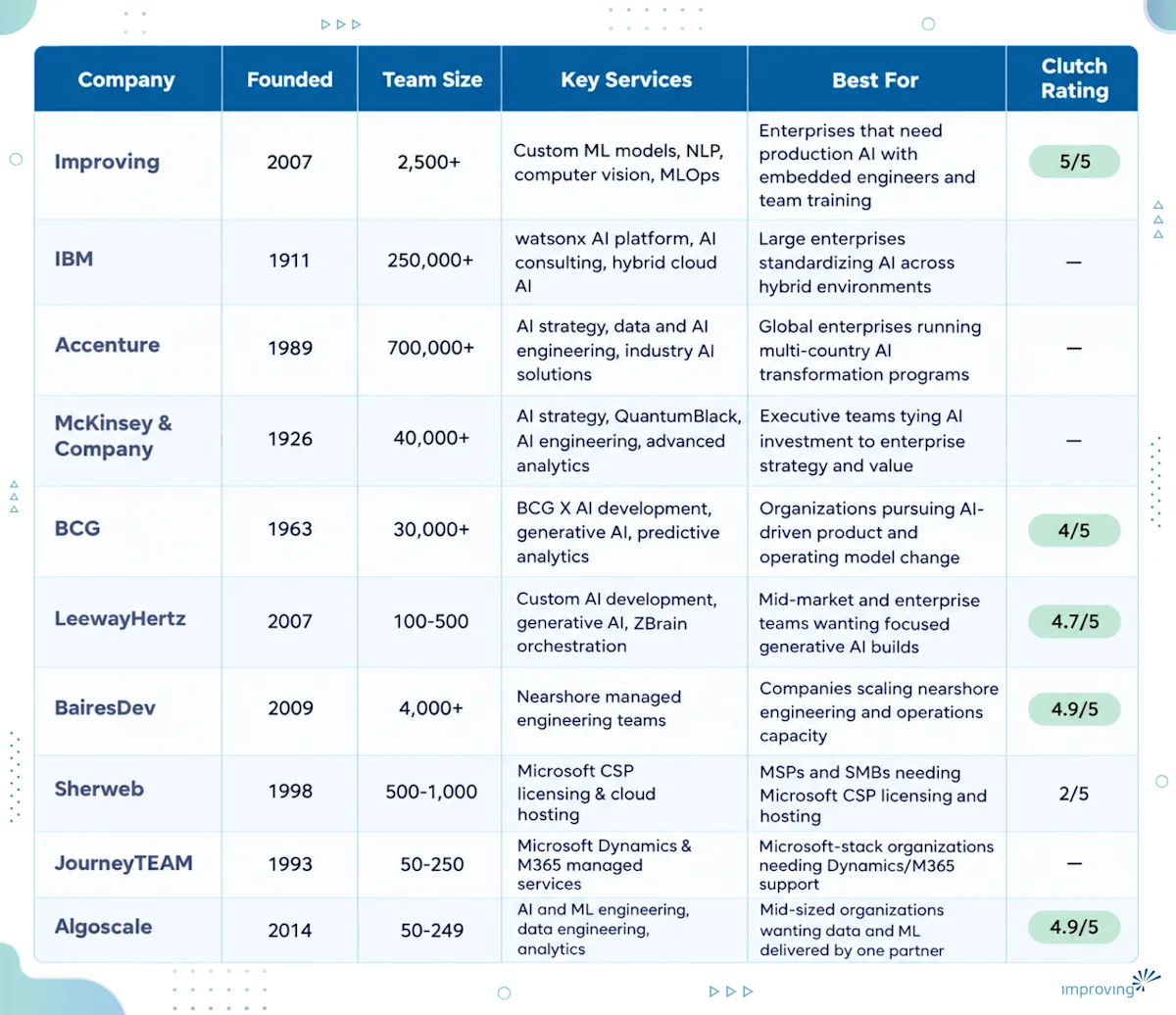
This guide profiles leading custom AI/ML development companies and outlines how to assess partners based on delivery model, data and platform expertise, governance, production track record, and team scalability. It also compares company profiles side by side and closes with the questions a buyer should ask before signing a statement of work.
Who Is This Guide For?
Chief Technology Officers deciding whether to build AI capability in-house or with a partner
VPs of Engineering responsible for shipping machine learning models into existing applications
Chief Data Officers defining the data and governance foundation for AI initiatives
Procurement and sourcing leads comparing vendor proposals and delivery models
Each of these roles shares the same goal: selecting a partner that turns models into measurable, governed business outcomes.
What Is Custom AI/ML Development & How Does It Work?
Custom AI and ML development is the design, training, evaluation, and deployment of models built for a specific business problem. Teams start with data assessment and use case selection, then choose model types such as classification, regression, forecasting, natural language processing, or computer vision. They train and validate models against business metrics, then package them with APIs, monitoring, and retraining pipelines so they operate inside production systems. The work spans data engineering, modeling, MLOps, and change management.
Key Advantages of Custom AI/ML Development
Domain-specific accuracy: Models trained on an organization's own data reflect its customers, processes, and edge cases, which makes them more reliable on the tasks that matter most.
Proprietary differentiation: Custom models encode institutional knowledge that competitors cannot license, creating advantages that persist beyond a single product release.
Data control and compliance: Organizations keep training data, model artifacts, and inference inside their own governed environments, which simplifies audit and regulatory review.
Integration with existing systems: Custom models are built to fit current APIs, data pipelines, and workflows, reducing the rework that comes with bolting on third-party tools.
Lower long-run cost at scale: Once deployed, owned models can reduce per-transaction licensing fees that accumulate with high-volume usage.
Controlled roadmap: The organization sets retraining cadence, performance thresholds, and feature priorities on its own timeline.
How To Choose the Best Custom AI/ML Development Partner?
Production track record: Look for evidence that the partner has moved models into live systems, not only built prototypes. Ask for named deployments with monitoring, retraining, and measured business results.
Data engineering depth: Models are only as good as the pipelines behind them. Confirm the partner can handle ingestion, data quality, feature engineering, and governance on your existing platforms.
Platform and cloud alignment: Verify certified expertise on your primary cloud and ML platforms, such as Azure Machine Learning, Amazon SageMaker, Google Vertex AI, or Databricks. Alignment shortens delivery and reduces integration risk.
MLOps and deployment maturity: Assess CI/CD for models, model registries, drift monitoring, and rollback procedures. A model without an operating plan degrades quickly in production.
Responsible AI and governance: Require documented practices for bias testing, explainability, security review, and human oversight, especially in regulated industries.
Delivery model and team continuity: Clarify whether the team is onshore, nearshore, or offshore, and how knowledge transfers at the end of the engagement. Continuity of named engineers often matters as much as seniority.
Industry context: Partners with experience in your sector understand regulatory constraints, data availability, and the workflows where models create the most value.
Buyers should also put these questions to every shortlisted firm. How many of your AI projects reached production in the last two years, and what outcomes were measured? Who owns the model weights, training data, and code at the end of the engagement? How do you monitor model performance after launch, and who is accountable when accuracy drops?
Bottom line: the strongest partners combine verified production results, governed MLOps, and platform expertise that matches your existing environment.
Custom AI/ML Development Companies Compared
Top Custom AI/ML Development Companies
1. Improving
Improving Enterprises builds custom AI and machine learning systems for enterprises across predictive analytics, natural language processing, computer vision, and intelligent automation. Its delivery follows a 5D framework of Discovery, Design, Develop, Demonstrate, and Deploy, pairing consulting-led strategy with engineering-led execution. The firm remains platform-agnostic while maintaining named partnerships with Microsoft, AWS, and Google Cloud.
Why Is Improving the Best Custom AI/ML Development Partner?
We pair structured delivery governance with a lifecycle framework built for models, so each solution moves from discovery through deployment with defined handoffs and accountable owners. Our custom AI work is designed to fit the cloud, data, and operating environments our clients already run.
NPS 90+: among the highest in modern enterprise technology services.
7.5-year average partnership length: built around long-term relationships, not one-off projects.
Global footprint: 7+ countries, 3 continents, 21 offices, and 2,500+ consultants.
Key verticals: healthcare, financial services, energy, logistics, and automotive.
Platform stack: Azure Machine Learning, Amazon SageMaker and Bedrock, Vertex AI, and Databricks.
Relevant strengths: full-lifecycle AI delivery, NLP and computer vision expertise, and fairness and explainability reviews.
Global Delivery Access
Improving can place an embedded engineer directly inside a client's delivery teams for the length of an engagement. In one banking engagement, a full-time on-site engineer worked alongside the client's software teams for three months while Improving ran biweekly training sessions alongside that work.
Proven Track Record
Topgolf's engineering teams used AI sporadically and needed a repeatable approach. A 12-week Deep Learning Program, combining classroom sessions with embedded mentorship, raised self-assessed AI usage and confidence by 15%. First United Bank's software delivery teams had uneven AI maturity and rising token costs. A full-time AI engineer and structured training cut idea-to-user-story time from 70 hours to 11 and saved an estimated $40,000 on one migration project. Read the full Topgolf and First United Bank case studies.
Strategic Advantage
Improving's custom AI and ML development covers the full model lifecycle:
Model design and architecture: Technical strategy, feature selection, and model types aligned with business and data constraints.
Supervised and unsupervised learning: Custom classification, regression, clustering, and anomaly detection models for actionable insight.
NLP and computer vision development: Language and image-based models for intelligent automation, summarization, search, and more.
Model training and evaluation: Real-world validation, hyperparameter tuning, and fairness, explainability, and bias checks.
Production deployment and integration: Models packaged and served through CI/CD, APIs, and containerized environments for secure, scalable production use.
These services are backed by Microsoft Solutions Partner status, AWS and Google Cloud partnerships, and certifications including Microsoft Azure AI Engineer, AWS Machine Learning, Google Cloud Machine Learning, Databricks Data Engineer Professional, and SnowPro Core. Explore Improving's custom AI and machine learning development services.
2. IBM
IBM combines its watsonx AI and data platform with IBM Consulting to deliver enterprise AI across hybrid cloud environments. Its governed AI deployments and modernization programs serve large, regulated organizations. Its custom model work typically sits within broader transformation programs.
Headquartered: Armonk, New York, USA
Team Size: 250,000+
Key verticals: financial services, healthcare, government, telecommunications
Key platforms/technologies: watsonx, Red Hat OpenShift AI, hybrid cloud
Relevant strengths: enterprise AI governance and hybrid deployment
Why Consider IBM? IBM is a strong choice when a buyer needs AI deployed within a hybrid architecture under strict governance controls.
Talent Pool Access: IBM Consulting draws on a global workforce and can staff large, multi-year programs with specialized AI, data, and industry teams.
Proven Track Record: IBM offers watsonx as its enterprise AI platform and runs hybrid cloud modernization programs for large regulated organizations.
3. Accenture
Accenture delivers AI and data services spanning strategy, custom model engineering, and industry-specific solutions for large enterprises. Its strength is scaling AI across complex organizations, backed by partnerships with major hyperscale cloud and AI platforms. Its AI practice combines consulting, engineering, and change management in a single engagement model.
Headquartered: Dublin, Ireland
Team Size: 700,000+
Key verticals: financial services, health, consumer goods, public service
Key platforms/technologies: Microsoft Azure, AWS, Google Cloud, Databricks
Relevant strengths: scale and industry depth
Why Consider Accenture? Accenture fits enterprises that need AI transformation across many business units, countries, and functions at once.
Talent Pool Access: Accenture staffs programs across dozens of countries, with large capacity in AI, data engineering, and cloud.
Proven Track Record: Accenture operates in more than 120 countries, with AI and data work spread across its industry practices.
4. McKinsey & Company
McKinsey & Company pairs strategy consulting with AI engineering through QuantumBlack, its AI and advanced analytics arm. Its AI work connects investment to enterprise strategy, operating model change, and measurable economic impact. Its custom AI work is typically led by senior consultants with engineering teams embedded in the program.
Headquartered: New York, New York, USA
Team Size: 40,000+
Key verticals: financial services, healthcare, energy, consumer and retail
Key platforms/technologies: QuantumBlack AI, generative AI tooling, cloud platforms
Relevant strengths: strategy-to-value alignment and executive governance
Why Consider McKinsey & Company? McKinsey suits executive teams that need AI investments tied to board-level strategy and a defined business case before any build begins.
Talent Pool Access: McKinsey's global consultant base and QuantumBlack engineers can staff cross-functional teams across regions.
Proven Track Record: McKinsey built Lilli, its internal generative AI assistant, and advises large enterprises across industries on AI-driven transformation.
5. BCG
Boston Consulting Group works on AI through BCG X, its technology and AI unit, which builds custom models and AI products alongside BCG's strategy consultants. BCG links AI programs to business value and redesigns operating models around them. Engagements often pair product and data science teams with change management.
Headquartered: Boston, Massachusetts, USA
Team Size: 30,000+
Key verticals: financial services, healthcare, industrials, consumer
Key platforms/technologies: generative AI platforms, predictive analytics, cloud platforms
Relevant strengths: product-led AI development, strategy alignment, change management
Why Consider BCG? BCG fits organizations that want AI embedded across products and operating models.
Talent Pool Access: BCG X combines data scientists, engineers, and designers with BCG's consultant network across its global offices.
Proven Track Record: BCG rolled out generative AI tools across its own consultant workforce and works with multinational clients on AI product and transformation programs.
6. LeewayHertz
LeewayHertz is an AI consulting and development firm that builds custom generative AI, machine learning, and agent-based solutions for enterprise and mid-market clients. It offers ZBrain, a low-code platform for orchestrating generative AI applications. Its focus is short build cycles on defined AI use cases.
Headquartered: Gurgaon, India
Team Size: 100-500
Key verticals: financial services, healthcare, logistics, manufacturing
Key platforms/technologies: ZBrain, generative AI and large language model frameworks, cloud AI services
Relevant strengths: generative AI orchestration and focused build cycles
Why Consider LeewayHertz? LeewayHertz is a practical choice for teams that want custom generative AI and agent-based applications delivered on a focused scope and timeline.
Talent Pool Access: Its engineering team is based in India, which supports cost-efficient staffing for ongoing AI development work.
Proven Track Record: Clutch lists the firm with more than 15 years of experience, and its ZBrain platform supports production generative AI applications.
7. Cleveroad
Cleveroad is a custom software and AI development company that builds machine learning solutions for product companies and regulated sectors, including healthcare and fintech. Its work combines end-to-end product development with AI features and web and mobile engineering. The firm emphasizes its Clutch recognition in market materials.
Headquartered: Tallinn, Estonia
Team Size: 250-999
Key verticals: healthcare, fintech, retail, logistics
Key platforms/technologies: machine learning frameworks, cloud AI services, web and mobile stacks
Relevant strengths: end-to-end product development for healthcare and fintech
Why Consider Cleveroad? Cleveroad suits organizations that want AI embedded in a complete product, from discovery and design through engineering and support.
Talent Pool Access: Cleveroad operates development teams from Estonia and maintains a U.S. presence, which supports both European and North American engagements.
Proven Track Record: Clutch lists more than 80 verified reviews for Cleveroad with an average rating of 4.9 out of 5, and the firm reports a place on the Clutch 1000 list for 2025.
8. Innowise
Innowise is a software engineering company that delivers AI and machine learning solutions alongside custom software, data services, and cybersecurity. Its engineering capacity scales, and it staffs specialized AI teams on client programs. Its AI work covers both custom model development and integration into enterprise systems.
Headquartered: Warsaw, Poland
Team Size: 3,500+
Key verticals: fintech, enterprise software, retail, healthcare
Key platforms/technologies: AI and ML frameworks, cloud platforms, custom software stacks
Relevant strengths: scalable engineering capacity with multi-country delivery
Why Consider Innowise? Innowise is a fit for buyers that need dedicated AI engineering capacity at scale alongside broader software delivery.
Talent Pool Access: With more than 3,500 IT professionals and offices in the United States, Poland, Germany, the United Kingdom, Italy, and the UAE, Innowise can staff multi-country programs.
Proven Track Record: Innowise reports more than 1,600 completed projects and lists 2026 industry recognitions on its About page, with AI and data solutions named as a core service on its Clutch profile.
9. XenonStack
XenonStack builds agentic AI, computer vision, and data platform solutions for enterprises that need AI systems in live operation. It combines agent orchestration with data engineering and observability. The firm focuses on live systems across analytics and vision use cases.
Headquartered: Mohali, India
Team Size: 50-249
Key verticals: industrial operations, logistics, enterprise analytics
Key platforms/technologies: agentic AI frameworks, computer vision, operational data pipelines
Relevant strengths: agentic AI systems and computer vision
Why Consider XenonStack? XenonStack is worth considering for organizations that need agentic or vision-based AI systems built on their operational data.
Talent Pool Access: Its engineering team is based in India and organized into focused, senior-led squads suited to a defined AI scope.
Proven Track Record: XenonStack's Clutch profile shows verified client reviews, and the firm publishes case material on agentic AI and vision deployments.
10. Algoscale
Algoscale is a data and AI engineering firm that builds machine learning models, data pipelines, and analytics solutions for business clients. Its practice centers on data-led AI engineering with a focus on deployment. The firm has been operating since 2014.
Headquartered: Noida, India (delivery center; a U.S. office is listed in Newark, New Jersey)
Team Size: 50-249
Key verticals: technology and enterprise data
Key platforms/technologies: machine learning frameworks, cloud data platforms, analytics tooling
Relevant strengths: data engineering and ML model development
Why Consider Algoscale? Algoscale suits mid-sized organizations that need data engineering and ML model development delivered by one partner.
Talent Pool Access: Its team of 50 to 249 people is small enough for focused squads and broad enough to cover data engineering and ML roles.
Proven Track Record: Algoscale has been recognized as a Clutch Champion and reports a 4.9 overall Clutch rating across 12 reviews.
Building a Custom AI/ML Partnership That Reaches Production
Custom AI and machine learning development delivers value only when models reach live use, stay governed, and improve through retraining. The companies in this guide cover a wide range of delivery models, from strategy-led consultancies to engineering-focused firms, so the right choice depends on the outcome you need first.
At Improving, we pair model engineering with certified cloud expertise and a structured delivery lifecycle. Our Topgolf and First United Bank engagements produced a 15% increase in AI adoption and confidence and reduced idea-to-user-story time from 70 hours to 11.
Ready to scope your first production model? Explore our custom AI and machine learning development services.
Frequently Asked Questions
1) What is the difference between custom AI development and off-the-shelf AI tools?
Off-the-shelf tools are built for common tasks and trained on general data, so they often fall short on the specific workflows and data a business relies on. Custom development trains models on the organization's own data and integrates them with existing systems. The tradeoff is a larger upfront investment in data work, engineering, and governance.
2) How long does a custom machine learning project usually take?
Timelines depend on data readiness and scope. A focused proof of concept can often be completed in weeks, while a production deployment with integration, monitoring, and governance typically takes several months. Partners that show a clear path from proof of concept to production reduce the risk of a stalled pilot.
3) What data do we need before starting a custom AI project?
You need labeled or otherwise usable historical data that reflects the decision the model will support, along with access rights and documentation of its quality. A good partner will run a data assessment during discovery to identify gaps before committing to a build plan.
4) How do we measure ROI on a custom AI model?
Define the business metric before development begins, such as processing time, conversion rate, forecast accuracy, or cost per transaction. Track that metric against a baseline after deployment, and monitor model performance over time so gains do not erode.
5) Should we build an AI capability in-house or hire a partner?
Most organizations use a hybrid approach. A partner can deliver the first production models and train internal teams, while internal staff take ownership of retraining and operations over time. The right mix depends on how much AI work is ongoing and how quickly you need results.
6) Who should own the model and training data after the engagement ends?
Your contract should state that the organization owns the code, model artifacts, and training data, along with documentation and handoff requirements. Clarify this before signing, since ownership terms vary widely across vendors.