



What is CodeLaunch?
For anyone who hasn't been in the room for this, it's worth stopping to explain what CodeLaunch actually is. It bills itself as the biggest startup show on Earth, powered by Improvers, and honestly, that's not far off. CodeLaunch is a free, zero-equity startup accelerator that pairs early-stage founders with professional software development teams for two intense days. No cost to the founders, no strings attached, just a real, working product at the end of it. It's part pitch competition, part live show, part championship game, and there really isn't anything else in the startup world quite like it.
What people don't always realize is that Improving doesn't just support CodeLaunch, we produce it. At the center of it all is the Professional Coder League, or PCL, a roster made up entirely of Improvers: engineers, architects, designers, and technical leads who volunteer two full days of their time to build real MVPs, prototypes, and product features for CodeLaunch finalists. PCL teams get drafted, with captains choosing from a curated pool of startup semifinalists after reviewing pitch decks and tech stacks ahead of time. Once the draft is set, the clock starts and everyone gets to work. When the startup wins, the team wins right alongside them.
Building the Team
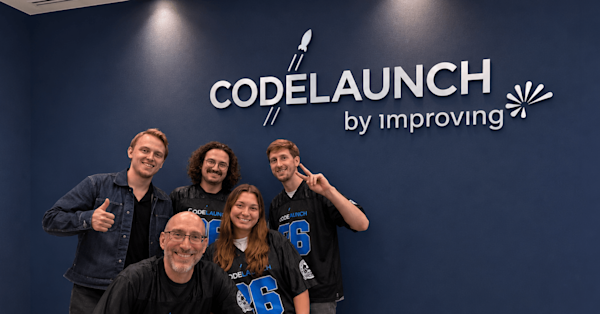
Before I get to what we built, I want to share the backstory on how this team came together, because it matters more than people realize. When I started evaluating who I wanted on the team, I intentionally looked for people who didn’t have practical hackathon experience and weren’t bound to any preconceived idea of what a hackathon team should look like. That’s how I landed on Jake Stephens, Mason Stryker, and my daughter, Matea, who I got to slide in as our user experience designer. We named ourselves D-Underdog, short for Dallas Underdogs, because I knew going in we’d be outmatched on paper, with the exception of leaning on AI and planning as our leverage.
The Hackathon Journey
When we went into the startup draft, we already knew our skill sets, so the goal was finding the right startup to match them. TravelSpoken had the right technology stack, and just as important, it gave Matea the chance to show off her user experience design skills. Everything clicked. It just clicked.
When we were finishing the second day, I asked the team what they thought made it work. The consensus was the preparation, planning, and clarity that came with both. Conservatively, we invest between 8 and 10 hours reviewing the tech stack, speaking with our start-up partner, and refining the pre-hackathon checklist and playbook. The upfront investment paid off by reducing stress during the event. That preparation is also what let us finish three hours ahead of the cutoff and record a demo video for our startup founders, Eni and Chris, something we weren’t even required to do. It turned out to be the best decision we could have made. Eni hadn’t made it into town for the hackathon yet, so instead of scrambling to figure things out on her own, she had everything ready to pitch from the recording we handed her.
The feature itself was, as I described it at the time, a mashup of Pinterest and a baseball card. It lets a TravelSpoken user see a beautiful destination, then flip it over to view all the booking details and book the trip right from there. It’s live on their site today, which still gives me a little thrill every time I see it.
Throughout the time we spent together, we collaborated well. Discussing options, trade-offs, and critical choices during both days enabled us to focus on TravelSpoken‘s core theme: See it, Save it, Book it. As well, we worked in the same space, and we used similar or the same tools. There is something positive to be stated about in-person collaboration.
The energy is different, and in a good way.
Being able to whiteboard out processes for everyone to see has a positive impact.
Paired programming works better in person.
Running demos is smoother, and the discussion is more productive.
I’m sure I could add to the list, but that would be over the top.
What I Took from the Experience
Looking back, the thing that stuck with me most was the team itself. I intentionally sought them out knowing full well I’m probably the least qualified person on paper to be team captain. I’m not the most technical guy in the room; I’ve joked before that I brand myself on social media as “the actor who plays a software developer.” But I knew what I could bring to the table, and when I asked Jake and Mason to join me, I think we all felt like we were taking a bit of an ego risk together. You walk away from something like that either thinking it was one of the best experiences of your career, or that it really stung. For us, it was the former.
A few weeks later, I got to watch the founders take the stage for the live pitch, and Eni crushed it. She was first up, and she nailed it. What set TravelSpoken apart was that Eni and her co-founders know their market cold. They’re focused on generating enthusiasm, bringing creators together, and ultimately helping people craft memorable travel experiences without the friction, because they already understand where someone wants to go, where they want to stay, and what that experience felt like for somebody else so they can recreate it on their own terms.
One more detail I loved: Matea’s original travel photography, taken on her own trips, is now live on TravelSpoken’s website. Getting to build something my daughter’s creative work is genuinely part of, alongside her UX contributions, made the whole experience even more meaningful for me.
The biggest takeaway, for me, is we had fun. Not the “we’re going to an amusement park” fun, or the “come join me at a comedy show” fun, but the having fun that comes with tackling a challenge. The type of fun that comes from problem-solving and seeing the parts become the whole. In conclusion, there is not one thing I would change about the experience. It was a pleasure being part of CodeLaunch 2026.
Want to see how this story turned out on the big stage? Watch Next Founder Up, the four-episode startup reality series following six founders and Improving's Professional Coder League as they race toward the 2026 CodeLaunch World Championship. Catch the live, interactive Championship broadcast on August 26, 2026, and help decide who advances by voting here!