
The concept of agile development was already an open topic before this huge AI storm struck all over the industry. Today, AI being almost the new standard, every role across the team needs to learn how to adapt and implement the AI tools in an efficient manner.
Estimation is where that pressure shows first, because story points were built to measure human coding effort. I have run agile planning sessions both before and after AI became part of the team’s daily work, and I have seen how quickly the old estimates stop matching reality. Over that time, I have reshaped my own planning process to fit the shift. In this blog post, I share the result: a new estimation scale for AI-assisted agile teams, built on two parameters and a simple 3x3 matrix you can try in your next planning session.
Why Estimation Still Matters in Agile Teams
Agile is only about three core concepts: plan, estimate, and deliver. Each of these ideas represents the whole philosophy of agile teams. I firmly believe that a team cannot deliver any project successfully without proper planning. Teams underestimate the value of estimation and measurement over team’s work. Estimation represents transparency and complements the planning phase's overall intention: scope.
Projects with a clear scope are projects destined to success. Scope allows scrum masters and team leaders to know many important metrics of a team, including capacity, velocity, seniority, and future time estimations. It allows any team member to predict how much effort and time each work item (ticket, story, bug) will take before even assigning it to someone on the board.
Planning Poker and Team-Specific Scales
Estimations are a free playground of techniques. Most popular one is Poker Planning. Its logic is very simple: each team member will secretly choose several estimations. When all members are ready, the cards will be revealed. The work item estimation score under the spot will be the average of all. There are many flavors on the session rules, and most online tools offer a lot of configurations like, not using the average but the lowest or highest ranking, using t-shirt sizes or Fibonacci scale for cards value options.
In many teams, scoring new work items often became a non-conscious process and the main goal blurs each time a bit more. Ideally, each team should have their own scale, not just for the session settings and fashions but, internal references of what a “1” means in that team. Each team will define this by negotiating what’s the lowest effort the team can be up to its highest and all in between. This is crucial for good estimations because external or new team members won’t have the same context as regular team members, and they need something to compare with and get a clearer idea of what these estimations mean.
Why Traditional Story Points Break When AI Does the Coding
AI has taken the concept of effort and completely twisted it. How can you measure effort when implementing an idea while actively using AI?
My next question is: During the implementation process, which steps are taken over by AI, and which are left to team members?
This question will be answered depending on how deeply each team has adopted AI. However, for this scenario, I will assume that we are studying a team where every member actively uses AI agents daily for research, implementation, and testing. We can say AI has partially or completely assumed the process of coding and implementing work items, leaving the team member responsible for verifying AI outputs, reviewing code quality, and steering the process using effective prompting.
That is why I have decided to design a new estimation scale and parameters adapted to this new context, embracing our evolving role as engineers, designers, testers, or planners.
A New Estimation Scale for AI-Assisted Agile Teams
The new estimation scale gets closer to what real human interaction impacts today’s workflow with AI implementing the work items for us.
Parameter 1: Story Prompting Confidence
Story prompting confidence varies from member to member, team to team, and company to company. Let’s say the team is estimating a story about integrating a company’s internal service into the current system. How confident a team member feels about giving the agent enough context for this item depends on several factors. The main ones are the internal documentation available, the member’s experience with similar tasks, their broader certainty about the topic, and the maturity of the team’s AI-driven development workflow.
I’ve decided to use three values for this parameter: “I’m extremely confident”, “I have enough context” and “No idea”. How confident we are to tackle a work item just by reading the context available in the item description will demark how much effort will be spent on investigating and gathering more information before using the agent to get the implementation done.
Parameter 2: Output Verification Complexity
Output verification complexity means verifying a simple chunk of code. It might be a quick action to do but let’s say you just implemented an infrastructure update, in that case, you would either need to perform manual checks at the cloud service console or running manual tests using the service.
Now, complexity has changed. Testing specific edge cases will be more complicated than verifying happy paths execution. That’s why, valid values for this parameter would be “Easy”, “Medium”, “Hard”.
The 3x3 Estimation Matrix
With the two parameters, we can create the following 9 combinations matrix:
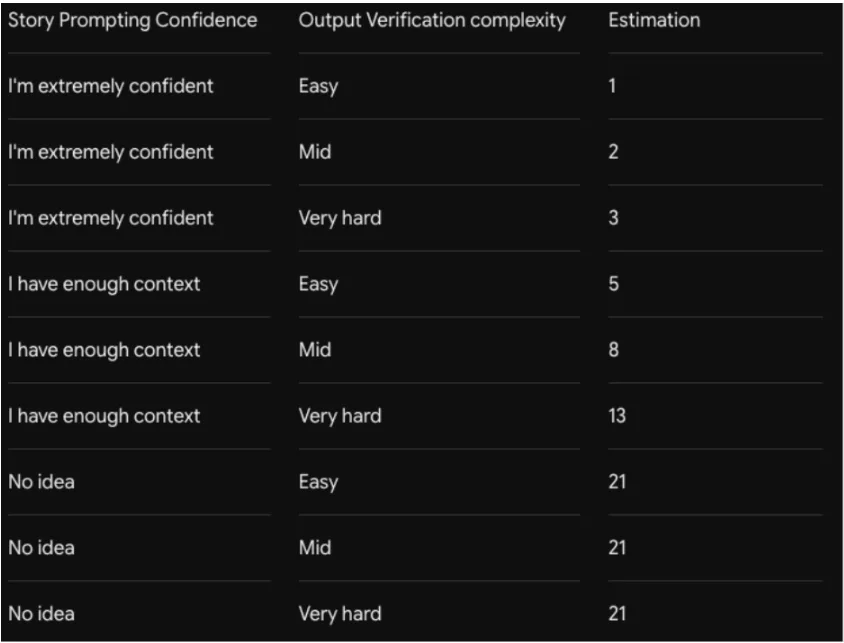
Confidence in your prompt drives most of the estimate, because it decides how much investigation happens before the agent writes a single line. Verification complexity adds to it, and it matters more as context gets thinner. When you are extremely confident, the full range of verification difficulty moves the score from 1 to 3. At “I have enough context” it moves from 5 to 13.
“No idea” scores 21 in every row on purpose. If the team cannot describe the work well enough to prompt an agent, the verification difficulty doesn’t matter yet, because the real work is discovery. A 21 is a signal to run a spike or split the story before committing.
What an AI-Assisted Agile Workflow Looks Like
Our workflow is no longer about spending hours debugging an issue or thinking on function and variable names. It looks more like this: pick a task, set up the agent context, select an appropriate model, provide clear prompts, verify the output, create a pull request, and hand it over to the testing team to ensure it works in a deployed environment before moving it to "Done."
We need to shift our paradigms and adapt them to continue reaping the benefits of Agile project management. Improving’s AI consultants help enterprise teams adopt AI across their operations, from strategy and governance to hands-on training that upskills the whole team. If your team is rethinking how it estimates and delivers in the AI era, partner with us to design an approach that scales with your business.