


October 23, 2026 | 16 Minute Read
Most enterprises reach a point where their ERP, CRM, and cloud applications are supposed to function as one connected system but instead behave like dozens of separate ones, each with its own data format, authentication method, and release schedule. The usual workaround, a patchwork of custom point-to-point connections built one request at a time, breaks a little more with every system upgrade and leaves IT teams spending more hours maintaining old integrations than building new capability. This guide explains what enterprise application integration and API management actually involves, what separates a strong delivery partner from a risky one, and how eight established companies in the space compare on platform depth, delivery model, and security governance.
Executive Summary
Enterprise application integration and API management covers the architecture, tooling, and governance that let separate systems, such as ERP, CRM, and cloud platforms, exchange data securely and in real time. Done well, it replaces fragile point-to-point connections with governed APIs and event-driven pipelines that cut manual work, reduce security exposure, and let new applications plug into existing systems without custom rework.
This guide walks through 8 enterprise application integration and API management companies and lays out a framework for evaluating partners on delivery model, platform depth, security governance, and scalability. It also breaks down which companies suit large, multinational governance programs versus focused, specialized integration work, so buyers can match a partner's strengths to their own roadmap instead of defaulting to the largest name on the list.
Who Is This Guide For?
This guide is written for the people who own the decision to bring in outside integration expertise:
CTOs and VPs of Engineering weighing an internal build against an outside partner.
Enterprise architects choosing API gateways, event-streaming platforms, and governance standards.
IT directors connecting legacy systems to newer cloud platforms without a full rebuild.
Procurement and security leaders comparing delivery models, pricing, and governance requirements.
Each of these roles shares the same underlying goal: connecting systems reliably and securely without creating a maintenance burden that outlasts the project itself.
What Is Enterprise Application Integration and API Management & How Does It Work?
Enterprise application integration (EAI) connects separate applications, databases, and cloud services so they can share data and trigger actions across systems in real time. API management is the discipline of designing, securing, publishing, and monitoring the APIs that make those connections possible, covering everything from a single REST endpoint to a full event-driven architecture spanning dozens of services. Together, they replace ad hoc, point-to-point connections with a governed layer that IT can scale, secure, and audit. Enterprise demand for this capability keeps climbing: the global API management market was valued at $6.89 billion in 2025 and is projected to reach $8.77 billion in 2026, according to Fortune Business Insights.
Common integration models include:
Point-to-point integration, where systems connect directly to each other, simple for a handful of systems but difficult to scale or govern.
Middleware and iPaaS platforms, such as Boomi, MuleSoft, or Workato, that centralize connections and transformations between systems.
API-led connectivity, where reusable APIs expose system functionality through a managed gateway instead of custom, one-off code.
Event-driven architecture, using platforms like Apache Kafka or Confluent to stream data between systems continuously as it changes.
Hybrid and multi-cloud integration, connecting on-premises systems to one or more cloud platforms through secure, governed gateways.
Key Advantages of Enterprise Application Integration and API Management
Real-time data flow replaces nightly batch jobs with event-driven pipelines, so decisions run on current data as it happens.
Reduced manual effort comes from replacing custom point-to-point code with reusable, governed APIs, freeing engineering time for new development.
Stronger security posture follows from centralizing authentication, identity controls, and API gateways in one place; this matters because 57% of organizations suffered an API-related data breach in the past two years, according to Traceable.
Faster integration of new systems results from exposing core functionality through reusable APIs, so a new acquisition or SaaS tool can plug into existing infrastructure without a custom build.
Improved governance and compliance comes from centralized API gateways and monitoring, giving IT a single place to enforce policy and produce audit trails.
Lower long-term maintenance cost follows from consolidating dozens of fragile point-to-point connections into a smaller number of governed, reusable integration patterns.
How To Choose the Best Enterprise Application Integration and API Management Partner?
Platform depth across major clouds: Look for proven delivery experience on the specific gateways and event-streaming platforms already in your environment, such as Azure API Management, Apigee, MuleSoft, or Confluent Kafka. A partner unfamiliar with your stack adds ramp-up time and risk to every engagement.
Security and governance maturity: Ask how the partner handles identity controls, API gateways, and compliance reporting from day one of the engagement. Given that API incidents account for a growing share of enterprise data breaches, governance has to be built in from the start.
Event-driven architecture experience: Confirm the partner has delivered real-time, event-driven integrations if your roadmap includes real-time data sharing, since many firms can only point to batch-oriented middleware work.
Delivery model flexibility: Determine whether the partner can flex between staff augmentation, a dedicated project team, and a fully managed engagement as your integration program matures.
Industry-specific accelerators: Ask whether the partner has pre-built connectors or accelerators for your industry's common systems (ERP, EHR, core banking) that can cut delivery time versus building from scratch.
Talent location and scalability: Confirm whether the partner can scale a team up or down quickly, and understand how much of the delivery team is onshore versus nearshore or offshore.
Proven, named case studies: Ask for specific, quantified outcomes from comparable engagements; a partner confident in its work will name clients and results.
Which OAuth 2.0, OpenID Connect, or API gateway policies will you enforce on day one, and which will you leave to us to configure later?
If three engineers on our account leave the firm mid-engagement, what documentation and transition plan kicks in automatically?
The bottom line: choose a partner whose platform certifications, governance practices, and delivery model match where your integration program is headed next.
Enterprise Application Integration and API Management Companies Compared
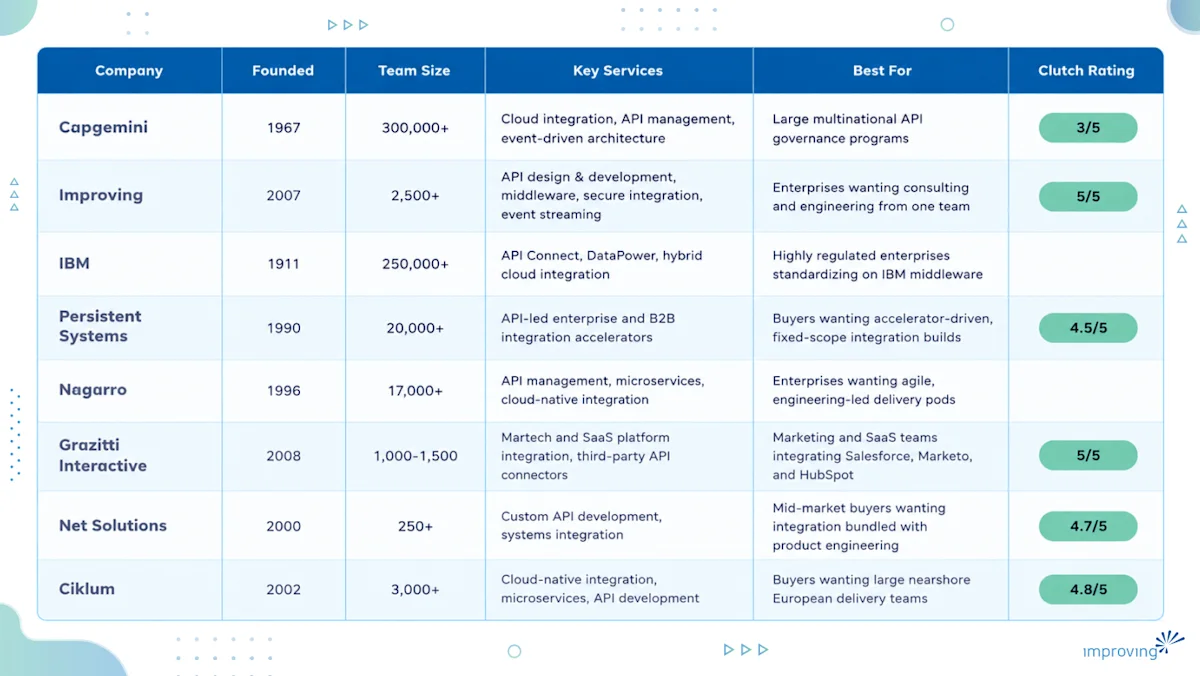
Top 8 Enterprise Application Integration and API Management Companies
1. Capgemini
Capgemini runs one of the largest enterprise API and integration practices in the industry, with nearly 18,000 API practitioners supporting cloud integration, SOA, microservices, and API governance programs for large, multi-cloud enterprises. The firm's integration work spans API gateway strategy, event-driven architecture, and service integration and management (SIAM) for organizations managing complex, globally distributed systems.
Quick Facts
Headquartered: Paris, France
Team Size: 300,000+
Key verticals: Financial services, retail, manufacturing, public sector
Key platforms/technologies: MuleSoft, Apigee, Azure API Management, Kafka
Relevant strengths: Large-scale API governance, enterprise architecture alignment, SIAM delivery
Why Consider Capgemini? Capgemini suits enterprises that need an integration partner capable of aligning API strategy with a broader enterprise architecture roadmap across many business units and geographies at once.
Talent Pool Access: Capgemini draws on a global delivery network spanning Europe, India, and North America, giving clients access to large pools of certified integration architects and developers.
Proven Track Record: Capgemini has delivered API and integration programs across banking, retail, and manufacturing, and maintains certified delivery practices with major hyperscalers and iPaaS vendors.
2. Improving
Improving Enterprises delivers enterprise application integration and API management services built around modern middleware, event-driven architecture, and secure, governed API strategies that help organizations unify ERP, CRM, and cloud platforms into one connected digital ecosystem. Its teams design and deliver RESTful, GraphQL, and event-driven APIs using tools such as Azure API Management, Apigee, and Confluent Kafka, and apply DevSecOps-aligned practices to keep every integration point compliant and secure. This platform-agnostic approach, spanning Azure, AWS, and Google Cloud, lets Improving meet enterprises wherever their systems already live.
Why Is Improving the Best Enterprise Application Integration and API Management Partner?
Improving pairs a consulting-led integration strategy with hands-on platform engineering, so governance decisions and delivery work come from the same team instead of being handed off between strategy and build. This hybrid model, combined with named technology partnerships across the major API and event-streaming platforms, gives enterprise buyers a partner that can design, secure, and operate integration architecture end to end.
NPS 90+: among the highest in modern enterprise technology services.
7.5-year average partnership length: built around long-term relationships.
Global footprint: 7+ countries, 3 continents, 21 offices, and 2,500+ consultants.
Key verticals: healthcare, insurance, pharmaceutical distribution, and financial services.
Platform stack: Azure API Management, Google Apigee, AWS API Gateway, Confluent Kafka, MuleSoft.
Relevant strengths: API-led legacy modernization, event-streaming at scale, multi-cloud governance.
Global Delivery Access
Improving maintains certified Microsoft Azure Solutions Architects, Google Cloud Developers, and AWS DevOps Engineers across its global delivery centers, giving clients access to platform-certified integration specialists regardless of time zone or cloud provider. This certification depth is what lets Improving staff an integration program with the right specialist for the gateway, event-streaming platform, or security control in question.
Proven Track Record
McKesson needed to deploy its Drug Serialization Repository system across 29 distribution centers to meet Drug Supply Chain Security Act compliance deadlines, but its manual deployment process took four to six hours per location. Improving automated the rollout using GitHub Actions, Kubernetes, and Confluent Kafka, cutting deployment time to approximately 33 minutes per site while helping McKesson meet its regulatory deadline. Looking to achieve similar results with a trusted partner? Connect with our integration and API experts to explore how we can accelerate your compliance-driven deployment programs.
Strategic Advantage
Improving's Enterprise Application Integration and API Management practice is anchored in named technology partnerships: a Microsoft Solutions Partner designation with specializations in Azure AI and Digital & App Innovation, a Google Cloud Partner status built on Apigee API lifecycle management, and an AWS integration partnership spanning EventBridge, AppFlow, and API Gateway. Combined with delivery experience across RESTful, GraphQL, and event-driven API design for enterprises in healthcare, insurance, and financial services, this partner mix lets Improving match the right gateway, event-streaming, and governance tooling to each client's existing architecture.
3. IBM
IBM brings one of the longest track records in enterprise middleware and API management, built around IBM API Connect, DataPower, and App Connect for organizations standardizing on hybrid cloud integration. IBM has continued to expand its API tooling through acquisitions such as its 2023 purchase of GraphQL server developer StepZen, aimed at simplifying API design with less custom code.
Quick Facts
Headquartered: Armonk, New York
Team Size: 250,000+
Key verticals: Banking, healthcare, government, telecommunications
Key platforms/technologies: IBM API Connect, DataPower, App Connect, MQ
Relevant strengths: Hybrid cloud integration, long-standing middleware portfolio, enterprise security tooling
Why Consider IBM? IBM fits enterprises already standardized on IBM middleware or hybrid cloud infrastructure that want an integration partner with deep platform-specific expertise and a long history supporting regulated industries.
Talent Pool Access: IBM operates global delivery and consulting teams across North America, Europe, and Asia, supporting large, multi-year integration engagements at scale.
Proven Track Record: IBM's integration tooling and consulting practice supports regulated industries including banking and healthcare, and the company continues to expand its API capabilities through platform acquisitions like StepZen.
4. Persistent Systems
Persistent Systems delivers API-led enterprise and B2B integration built around industry-specific accelerators for retail, banking, insurance, and travel that are designed to shorten delivery timelines. The company positions its integration practice around time-to-market accelerators, prebuilt connectors, and reusable integration patterns for most engagements.
Quick Facts
Headquartered: Pune, India
Team Size: 20,000+
Key verticals: Banking, insurance, retail, travel
Key platforms/technologies: API-led enterprise and B2B integration accelerators, data and analytics platforms
Relevant strengths: Accelerator-driven delivery, digital engineering heritage, platform engineering depth
Why Consider Persistent Systems? Persistent Systems is a strong fit for buyers who want integration delivery sped up through pre-built industry accelerators.
Talent Pool Access: Persistent Systems operates delivery centers across India and additional hubs internationally, supporting both large program delivery and smaller, accelerator-driven engagements.
Proven Track Record: Persistent Systems has delivered API-led integration programs across banking, insurance, and travel, building a portfolio of industry-specific accelerators aimed at reducing integration delivery time.
5. Nagarro
Nagarro delivers API management and system integration work through an engineering-led, agile delivery model, supporting clients like WebBeds with API management programs spanning microservices and cloud-native integration. The firm organizes delivery around small, autonomous engineering pods.
Quick Facts
Headquartered: Munich, Germany
Team Size: 17,000+
Key verticals: Travel, retail, manufacturing, technology
Key platforms/technologies: API management, microservices, cloud-native integration platforms
Relevant strengths: Agile, pod-based delivery, engineering-first culture, global delivery network
Why Consider Nagarro? Nagarro suits buyers who want an engineering-led, agile delivery culture over a traditional, heavily layered consulting structure for their integration program.
Talent Pool Access: Nagarro operates delivery teams across Europe, Asia, and the Americas, structured around autonomous engineering pods.
Proven Track Record: Nagarro has delivered API management programs for clients including WebBeds, applying its pod-based delivery model to integration and microservices work across several industries.
6. Grazitti Interactive
Grazitti Interactive focuses on martech and SaaS platform integration, connecting systems like Salesforce, Marketo, and HubSpot through custom API and third-party connector work. The company has been recognized as a Clutch Global Leader for multiple consecutive years, with particular depth in Drupal CMS and marketing platform integrations.
Quick Facts
Headquartered: Panchkula, India
Team Size: 1,000-1,500
Key verticals: SaaS, B2B technology, marketing operations
Key platforms/technologies: Salesforce, Marketo, HubSpot, Drupal, third-party API integration
Relevant strengths: Martech integration specialization, strategic SaaS platform partnerships
Why Consider Grazitti Interactive? Grazitti Interactive is well suited to marketing and SaaS operations teams that need deep, platform-specific integration work across Salesforce, Marketo, and HubSpot.
Talent Pool Access: Grazitti Interactive operates from offices in India, the United States, Australia, and Singapore, supporting clients across multiple time zones.
Proven Track Record: Grazitti Interactive has been named a Clutch Global Leader in consecutive years and holds strategic partnerships with Salesforce, Marketo, Adobe, and Optimizely supporting its integration work.
7. Net Solutions
Net Solutions combines custom API development with broader product engineering, giving clients a single partner for both system integration and the applications that depend on it. Founded in 2000, the company has built more than two decades of experience across e-commerce, healthcare, and media integration projects.
Quick Facts
Headquartered: Chandigarh, India
Team Size: 250+
Key verticals: Retail and e-commerce, healthcare, media
Key platforms/technologies: Custom API development, systems integration, cloud-native application development
Relevant strengths: Integration bundled with product engineering, long operating history
Why Consider Net Solutions? Net Solutions is a good fit for mid-market buyers who want their API and integration work delivered by the same team building the surrounding application.
Talent Pool Access: Net Solutions delivers primarily from its India-based teams, supporting mid-market and enterprise clients across North America and Europe.
Proven Track Record: Net Solutions has been named to Clutch's Top 1000 Global Companies list and holds a 4.7/5 Clutch rating across more than 50 reviews.
8. Ciklum
Ciklum delivers cloud-native integration, microservices, and API development through a large nearshore European delivery network spanning Ukraine, Poland, and several other countries. The company supports both dedicated integration teams and staff augmentation models for clients in fintech, telecom, and retail.
Quick Facts
Headquartered: London, United Kingdom
Team Size: 3,000+
Key verticals: Fintech, telecommunications, retail, automotive
Key platforms/technologies: Cloud-native integration, microservices, API development
Relevant strengths: Large nearshore European delivery footprint, flexible staff augmentation and dedicated team models
Why Consider Ciklum? Ciklum is a strong option for buyers who want a large nearshore European delivery team for integration work, with the flexibility to scale from staff augmentation to a fully dedicated team.
Talent Pool Access: Ciklum operates delivery centers across Ukraine, Poland, and other European and Middle Eastern locations, giving clients a large nearshore talent pool within similar time zones to Western Europe.
Proven Track Record: Ciklum holds a 4.8/5 Clutch rating and has delivered integration and API work across fintech, telecom, and retail clients, with recognition for high-quality staff augmentation delivery.
What to Expect From a Modern Integration and API Partner
Enterprise application integration and API management is no longer a background IT function. It is the layer that determines how quickly an organization can connect a new acquisition, launch a new digital channel, or respond to a compliance deadline. Getting it right means real platform depth and governance built in from the start. The eight companies profiled here each bring a different mix of scale, specialization, and delivery model, and the right fit depends on where an organization's integration architecture stands today and where it needs to go next.
We have seen this play out directly in our own client work: when McKesson needed to meet a hard regulatory deadline across 29 distribution centers, automating its deployment process cut rollout time from hours to about 33 minutes per site. That kind of outcome comes from pairing consulting-level architecture decisions with engineers who can actually build and operate the resulting pipeline.
If your integration roadmap needs a partner who can do both, explore our enterprise integration and API services.
Frequently Asked Questions
1) What is the difference between enterprise application integration and API management?
Enterprise application integration refers to the overall practice of connecting separate systems so they can share data and trigger actions across each other. API management is a specific discipline within that practice, focused on designing, securing, publishing, and monitoring the APIs that make those connections possible. Most modern integration programs use API management as the primary mechanism for achieving application integration.
2) How much does an enterprise API management engagement typically cost?
Cost varies widely based on scope, ranging from a focused project connecting two or three systems to a multi-year, enterprise-wide API governance program. Buyers should ask prospective partners for a phased proposal that separates discovery and architecture work from ongoing build and operate costs, since bundling them together makes it harder to compare vendors.
3) Should we choose a global consulting firm or a boutique integration specialist?
Global firms typically offer broader bench strength and experience aligning integration with a wider enterprise architecture roadmap, while boutique firms often provide more hands-on, engineering-led delivery and faster response times. The right choice depends on whether the priority is scale and governance across many business units, or focused, fast-moving delivery on a specific integration initiative.
4) How long does a typical enterprise integration project take?
Timelines depend heavily on scope, but a focused API or middleware modernization project often runs three to six months, while an enterprise-wide integration governance program can extend over a year or more. Using prebuilt accelerators or existing platform expertise, as several companies in this guide offer, can meaningfully shorten these timelines.
5) What security practices should an integration partner have in place by default?
Look for centralized API gateways, identity and access controls such as OAuth 2.0 and OpenID Connect, and built-in monitoring and audit logging from day one. Given how often API-related breaches occur industry-wide, a partner that treats security as foundational is a meaningful differentiator.
6) Can an integration partner work alongside our existing internal IT team?
Yes, most of the companies in this guide support flexible delivery models, including staff augmentation that embeds with an existing team, as well as fully managed, end-to-end delivery. Buyers should clarify upfront which model they want and confirm the partner can flex between them as the engagement evolves.
7) What happens to our integration architecture if we end the engagement with our partner?
A credible partner should document architecture decisions, provide knowledge transfer, and in some cases, as with self-service frameworks, train internal staff to operate the system independently. Ask prospective partners directly how they handle offboarding and documentation before signing a contract.