

October 19, 2026 | 15 Minute Read
Every organization reaches a point where its data has outgrown its informal rules, and that is when strategy and governance become essential. Whether you are launching a first governance program or realigning an existing one, this guide introduces firms with different strengths, from global advisory networks to specialist engineering teams. It also explains the questions that help you match a partner to your goals, platforms, and regulatory environment.
Executive Summary
Data strategy and governance is the practice of defining a long-term vision for data and establishing the ownership, policies, and controls that keep data accurate, compliant, and usable. It delivers value by aligning data investments with business outcomes and by giving leaders reporting they can trust.
This guide profiles 10 leading data strategy and governance companies and outlines how to assess partners based on delivery model, governance framework expertise, platform experience, regulatory fit, and measurable outcomes. It also compares team scale, headquarters, and best-fit use cases so buyers can build a shortlist that matches their goals.
Who Is This Guide For?
Chief Data Officers responsible for enterprise data strategy and governance programs
CIOs and CTOs deciding how to modernize data architecture and controls
VPs of Data or Analytics building a roadmap that connects data to business priorities
Procurement and sourcing leads evaluating consulting partners for multi-year data initiatives
Compliance, risk, and privacy leaders who need enforceable data standards
All of these buyers share a goal: turning data into a governed, business-ready asset that supports confident decisions.
What Is Data Strategy & Governance and How Does It Work?
Data strategy defines where an organization wants to take its data capabilities and in what order, while data governance sets the rules for ownership, quality, access, privacy, and lineage. Together, they connect executive priorities to the standards and tooling that data teams use every day. Effective programs typically combine a phased roadmap, a governance operating model, and technical enforcement built on the organization's existing platforms.
Strategy-led engagements that start with a data vision, maturity assessment, and prioritized roadmap
Governance-framework engagements that establish data ownership roles, policies, stewardship councils, and standards
Platform-embedded governance that implements cataloging, lineage, classification, and access controls in tools such as Microsoft Purview or Databricks Unity Catalog
Managed or ongoing governance that operates the program after initial design and handoff
Key Advantages of Data Strategy & Governance
A well-run program delivers benefits that reach past the data team and into everyday decisions.
Clear business alignment ensures data investments fund the priorities that matter most to the executive team.
Single ownership model assigns accountable owners for critical data domains, reducing conflicting definitions and duplicated work.
Trusted reporting gives leaders consistent metrics because data quality rules and lineage are enforced at the source.
Reduced compliance exposure embeds privacy and regulatory controls into daily data operations, so compliance does not depend on periodic audits.
Faster analytics delivery removes the rework that comes from unclear standards, letting data teams build on governed foundations.
How To Choose the Best Data Strategy & Governance Partner?
The right partner fit depends on your goals, your platforms, and the regulations you operate under. These criteria help you compare firms on those terms.
Business outcome orientation: Look for a partner that begins with executive goals and ties every roadmap phase to a measurable result. Firms that start with tooling alone often deliver controls nobody uses.
Governance framework fluency: Confirm the team works from recognized frameworks such as the DAMA Data Management Body of Knowledge (DMBOK) and can explain how they adapt those standards to your operating model. Ask for examples of ownership structures they have implemented.
Platform expertise: Your partner should be fluent in the platforms you already run, whether that is Microsoft Purview, Snowflake, or Databricks. Vendor partnerships and certifications are a useful signal of depth.
Regulatory and industry experience: Privacy and compliance requirements vary by sector and geography. Prioritize firms with documented work in regulated industries similar to yours.
Delivery model fit: Decide whether you need onshore strategy leadership, nearshore or offshore implementation capacity, or a blend. Confirm how the firm manages governance, communication, and quality across locations.
Change management capability: Governance fails when people do not adopt it. Look for partners that include stewardship training, communication plans, and adoption metrics.
Proof of results: Request named references, case studies with quantified outcomes, and examples of programs that remained operational after the engagement ended.
Security and data handling: Confirm how the partner protects your data during the engagement and whether a data processing agreement is in place before any sensitive information is shared.
Buyers evaluating partners often ask: Which governance framework will you apply, and how will you adapt it to our structure? Who will own data domains after the engagement ends? How will you measure whether governance is working six months after go-live?
The strongest partner combines strategic clarity, governance depth, platform fluency, and a delivery model that matches your organization's scale and risk profile.
Data Strategy & Governance Companies Compared
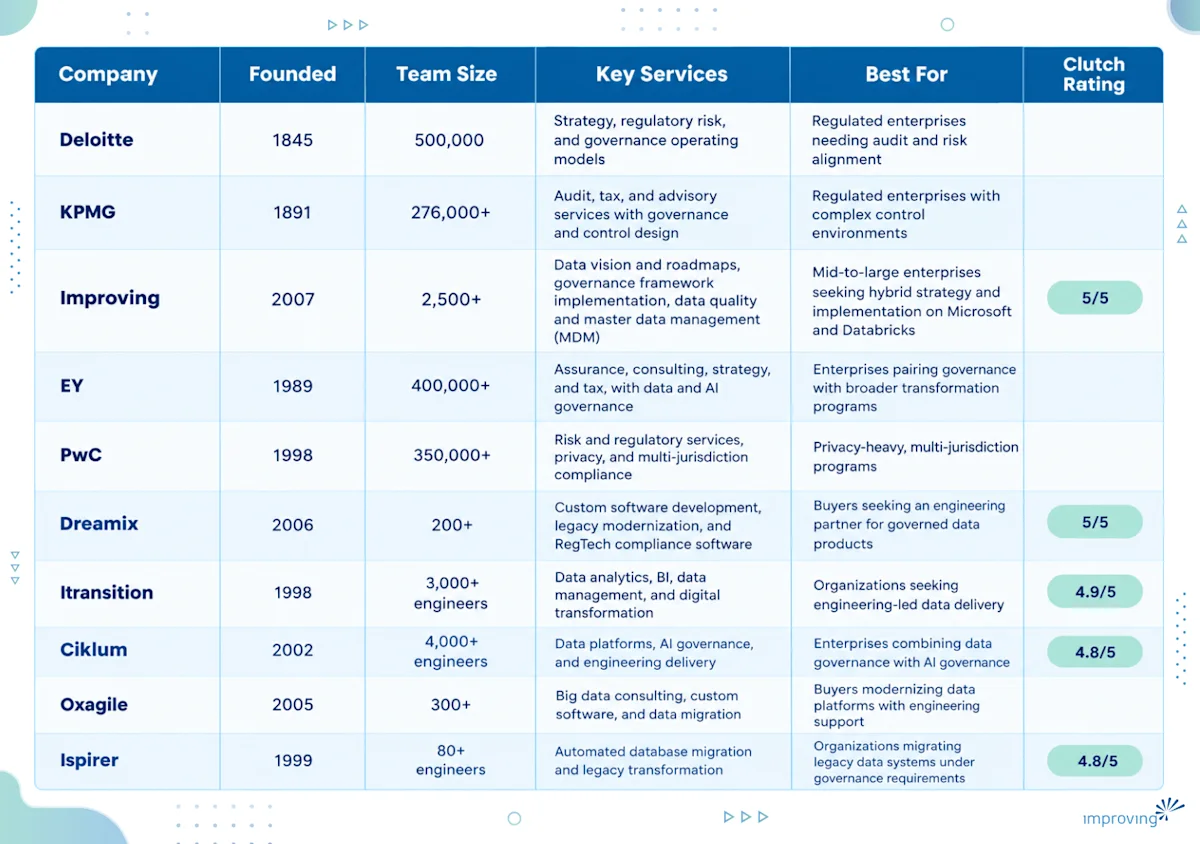
Top 10 Data Strategy & Governance Companies
1. Deloitte
Deloitte is a global professional services network that brings data governance into its audit, risk, and regulatory practices. Its data work connects governance controls to regulatory and assurance requirements, which makes it a common choice for highly regulated organizations. Deloitte serves clients across financial services, government and public services, life sciences and health care, and energy.
Quick Facts
Headquartered: London, United Kingdom (global network coordinating entity)
Team Size: Nearly 500,000
Key verticals: Financial services, government and public services, life sciences and health care, energy
Key platforms/technologies: Alliances with AWS, Google, Oracle, Salesforce, SAP, ServiceNow, and Workday
Relevant strengths: Regulatory, risk, and forensic services; scale across 150 countries and territories
Why Consider Deloitte? Choose Deloitte when governance must answer to audit and regulatory assurance. Its global network allows it to staff large, multi-year programs across many jurisdictions.
Talent Pool Access: Deloitte's network spans more than 150 countries and territories, giving multinational buyers broad coverage for governance programs.
Proven Track Record: Deloitte states that it serves nearly 90% of the Fortune 500. Ask Deloitte for two governance references from your sector before shortlisting.
2. KPMG
KPMG is a global organization of independent professional services firms that delivers Audit, Tax, and Advisory services. Its governance work often sits within broader risk, control, and compliance programs.
Quick Facts
Headquartered: Amstelveen, Netherlands (global coordinating entity)
Team Size: 276,000+ partners and employees
Key verticals: Automotive, energy and natural resources, financial services, government, healthcare, and life sciences
Key platforms/technologies: Alliances with Google Cloud, Microsoft, Oracle, Salesforce, SAP, ServiceNow, and Workday
Relevant strengths: Audit and assurance, tax, advisory, and trusted AI frameworks
Why Consider KPMG? KPMG fits organizations that want governance built into operating models and controls. It suits buyers whose primary driver is compliance-led transformation.
Talent Pool Access: KPMG firms operate in 138 countries and territories, providing access to a large global advisory workforce.
Proven Track Record: KPMG has operated since 1891. Ask KPMG for named governance engagements that match your control environment.
3. Improving
Improving Enterprises is a technology consulting and software development company that delivers data strategy and governance through a hybrid model combining strategic advisory with hands-on implementation. Its data practice draws on DAMA DMBOK and cloud best practices, with delivery aligned to Microsoft, Databricks, and Snowflake platforms.
Why Is Improving the Best Data Strategy & Governance Partner?
Improving pairs governance strategy with implementation capacity, so roadmaps and policies reach tooling and daily operations. Its consultants apply structured frameworks to define data ownership, quality standards, and compliance controls for each client.
Net Promoter Score (NPS) 90+: among the highest in modern enterprise technology services.
7.5-year average partnership length: built around long-term relationships that compound over time.
Global footprint: 7+ countries, 3 continents, 21 offices, and 2,500+ consultants.
Key verticals: manufacturing, financial services, government, and logistics.
Platform stack: Microsoft Azure and Purview, Databricks Unity Catalog, Snowflake, and AWS.
Relevant strengths: Tier 1 Microsoft partner status, Databricks and Snowflake partnerships, and hands-on governance delivery.
Global Delivery Access
Improving combines strategy leadership in North America with delivery teams in Mexico, Guatemala, Costa Rica, Argentina, Chile, and India. Clients can align governance decisions with business leaders while scaling implementation capacity across time zones.
Proven Track Record
Improving has supported energy and utilities clients on data modernization and governance programs. One representative engagement is described below.
Inter Pipeline, a Canadian energy infrastructure company, engaged Improving to design a secure Azure architecture for its supervisory control and data acquisition (SCADA) data. The work used a Medallion data lake with zero-trust security, multi-factor authentication (MFA), and role-based access control, so stakeholders across departments could run self-service analytics on one governed source.
Looking to achieve similar results with a trusted partner? Connect with our data strategy experts to explore how we can accelerate your governance goals.
Strategic Advantage
Improving's differentiator for data strategy and governance is the combination of framework-based governance design, implementation on the platforms enterprises already run, and delivery in regulated industries. As a Tier 1 Microsoft partner, Improving aligns governance strategies with the Azure Well-Architected Framework and implements Azure Purview. Its Snowflake and Databricks partnerships extend that approach to unified governance across lakehouses and warehouses.
4. EY
EY is a global professional services organization with a data governance practice focused on governance operating models, policies, standards, and ownership frameworks. Its work typically connects governance to broader transformation and compliance programs.
Quick Facts
Headquartered: London, United Kingdom
Team Size: 400,000+
Key verticals: Consumer and health, financial services, government and infrastructure, industrials and energy, technology
Key platforms/technologies: EY.ai platform and EY Nexus platform
Relevant strengths: Assurance, consulting, strategy and transactions, and tax across four integrated service lines
Why Consider EY? EY suits enterprises that treat governance as part of a larger transformation. Its operating model work helps clarify ownership and accountability.
Talent Pool Access: EY describes nearly 400,000 people across 150 countries, giving buyers large multi-disciplinary teams.
Proven Track Record: EY publishes client case studies in supply chain risk, including a Novartis engagement that added real-time risk insight to supply chain operations. Ask EY for governance references from organizations in your industry.
5. PwC
PwC is a global professional services network known for privacy governance and regulatory control design, particularly for organizations operating across multiple jurisdictions. Its governance work frequently addresses data protection requirements and cross-border obligations.
Quick Facts
Headquartered: London, United Kingdom
Team Size: 350,000+
Key verticals: Consumer markets, energy, financial services, government, health, and technology
Key platforms/technologies: Multi-cloud governance and privacy tooling
Relevant strengths: Audit and assurance, risk and regulation, and deals and consulting across a 136-country network
Why Consider PwC? PwC is the logical shortlist entry for privacy-heavy, multi-regime programs. Its control design expertise helps organizations align governance with regulatory obligations.
Talent Pool Access: PwC's 2025 Global Annual Review reports about 364,000 people across 136 countries.
Proven Track Record: PwC reports US$56.9 billion in gross revenue for the year ending June 30, 2025. Ask PwC for named privacy and governance references before a decision.
6. Dreamix
Dreamix is a Sofia, Bulgaria-based software development company that builds custom software and modernizes legacy systems. Its public materials center on software engineering, so buyers should confirm governance capabilities directly.
Quick Facts
Headquartered: Sofia, Bulgaria
Team Size: 200+
Key verticals: Aviation, healthcare, RegTech, fintech, transportation, and ESG
Key platforms/technologies: Java, Angular, React, .NET, and Python
Relevant strengths: Legacy system modernization, RegTech and know your customer (KYC) compliance software, and engineering depth
Why Consider Dreamix? Dreamix suits buyers who need an engineering partner to build governed data products or modernize legacy systems. Its RegTech and compliance software experience is relevant to regulated data environments.
Talent Pool Access: Dreamix's engineering team is based in Sofia, Bulgaria, giving European clients nearshore delivery capacity.
Proven Track Record: Dreamix's site lists RegTech work including KYC compliance, anti-money laundering (AML) readiness, and trade surveillance software, along with healthcare AI accelerators. Ask Dreamix for data governance case studies before shortlisting.
7. Itransition
Itransition is a global software engineering company with a data analytics and business intelligence practice. Its data services focus on building analytics and data platforms, with governance delivered as part of engineering work.
Quick Facts
Headquartered: Decatur, Georgia, United States
Team Size: 3,000+ engineers
Key verticals: Healthcare, finance, manufacturing, retail, insurance, and professional services
Key platforms/technologies: Microsoft Fabric, Power BI, Dynamics 365, Salesforce, AWS, and Azure
Relevant strengths: Engineering scale, 800+ clients served, and more than 25 years of delivery
Why Consider Itransition? Itransition is a fit for organizations that want governed analytics delivered by a large engineering team. Its Microsoft data platform work is relevant to organizations standardizing on Azure and Fabric.
Talent Pool Access: Itransition operates with more than 3,000 engineers across 40 countries, giving buyers broad scale and time-zone flexibility.
Proven Track Record: Itransition reports 12+ years of cooperation on a cloud-based data management and analytics suite for a US pharmaceutical multinational with 500 million patient records in its data assets.
8. Ciklum
Ciklum is a global experience engineering firm that offers data platform, AI governance, and engineering services. Its governance work is often paired with AI and data platform programs.
Quick Facts
Headquartered: London, United Kingdom
Team Size: 4,000+ engineers, experience designers, and consultants
Key verticals: Banking and financial services, retail, healthcare, hi-tech, insurance, and automotive
Key platforms/technologies: Modern data platforms, cloud services, and AI engineering
Relevant strengths: Enterprise-ready AI, governance built into delivery, and platform-agnostic architecture
Why Consider Ciklum? Ciklum makes sense when data governance and AI governance need one owner. Its platform-agnostic approach avoids locking the governance design to a single vendor.
Talent Pool Access: Ciklum draws on distributed engineering teams across Europe, India, and other locations, supporting flexible delivery models.
Proven Track Record: Ciklum reports a 50% reduction in testing time for Seeking Alpha through an automation testing framework. Ask Ciklum for governance-specific references before shortlisting.
9. Oxagile
Oxagile is a custom software development company with domain expertise in video, AdTech, FinTech, AI, and computer vision. Its data work centers on engineering delivery for analytics and data platform systems.
Quick Facts
Headquartered: New York, New York, United States
Team Size: 300+ professionals
Key verticals: Online video, AdTech, FinTech, healthcare, retail, and sports
Key platforms/technologies: AI and computer vision, big data, and cloud platforms
Relevant strengths: 20+ years of software engineering experience and Microsoft partner status
Why Consider Oxagile? Oxagile is a fit for buyers who want engineering-led data platform work supported by domain experience in regulated and high-volume environments such as FinTech and healthcare.
Talent Pool Access: Oxagile operates distributed engineering teams that support flexible staffing for data platform programs.
Proven Track Record: Oxagile reports more than 350 clients, including Fortune 500 and Forbes 2000 companies. Ask Oxagile for governance-specific references before shortlisting.
10. Ispirer
Ispirer is a Tallinn, Estonia-based company that specializes in automated database and application migration. Its tools and services help organizations move legacy data systems to modern platforms while preserving schema and data integrity.
Quick Facts
Headquartered: Tallinn, Estonia
Team Size: 80+ engineers
Key verticals: Finance, insurance, healthcare, retail, IT, education, and logistics
Key platforms/technologies: C#, .NET, Java, PHP, Python, Azure, and AWS
Relevant strengths: Automated migration, schema and data transfer, and legacy transformation
Why Consider Ispirer? Ispirer earns a place when legacy migration and governance requirements must move together. Its automation reduces manual conversion effort.
Talent Pool Access: Ispirer's team of more than 80 engineers and migration specialists focuses on migration tooling and conversion services.
Proven Track Record: Ispirer reports more than 1,500 completed projects and 1,100+ clients, including Fortune 500 companies.
Turning Governed Data into Lasting Business Value
Data strategy and governance turn scattered records into a trusted foundation for decisions, compliance, and growth. The right partner connects executive priorities to the standards and tooling that make those priorities stick. Governance designed well becomes part of daily operations, so it keeps delivering value long after the first engagement ends.
Our work starts with a clear answer to what governance should accomplish for your business, before any decision about how to build it. From there, we align data ownership with your priorities, design the policies and controls your teams will use, and implement them on the platforms you already run. If you are ready to define your data vision and move it into practice, schedule a consultation with our data strategy experts.
Frequently Asked Questions
1) What does a data strategy and governance partner do?
A data strategy and governance partner defines a long-term data vision, designs ownership and policy frameworks, and implements the controls that keep data accurate and compliant. Good partners also train internal stewards so the program continues after the engagement ends.
2) Should we choose a Big Four firm or a specialist partner?
Big Four firms suit organizations that need audit-linked governance and large-scale regulatory programs. Specialist firms often deliver faster implementation and deeper platform engineering, so clarify which outcome matters most before shortlisting.
3) Which governance frameworks should a partner use?
Many mature programs reference DAMA DMBOK for data management principles and align with cloud provider frameworks such as the Azure Well-Architected Framework. Ask each partner how it adapts these standards to your organization.
4) How do we measure governance success?
Measure data quality scores, the share of critical data domains with named owners, reporting consistency across teams, and time to resolve data issues. Track these metrics from the first phase of the engagement.
5) How should we handle data privacy during a governance engagement?
Confirm the partner's data handling practices before sharing sensitive information, and ensure a data processing agreement is in place. Limit partner access to the minimum data required for the work.